
When You Hire a CBLP for Your Project, You Join a Community
This month we’re sharing the stories of experts who have taken the CCLC’s Chesapeake Bay Landscape Professional training and why seeking out a “certified pro” for your next landscaping job makes sense for you and the environment.
In our first installment, we met David Chewey (LINK), a landscape architect based in Virginia Beach who urges more homeowners to seek out CBLP-trained professionals for their projects. Then landscape architect, Master Gardener, certified arborist, mentor, advocate, and owner of the Groundsmith Collective, Kelley Oklesson (LINK) spotlighted how CBLPs can introduce you to a new way of seeing your garden.
Today, we meet Justin Ulanoski.
-Beth Ginter, Executive Director, CCLC
Meet Justin Ulanoski, Pennsylvania Landscape Professional, and Founder of Native Creations Landscape Services
CBLPs Are Part of a Large and Growing Conservation Network
For Justin Ulanoski, the president of Native Creations Landscape Services in Pennsylvania, what he learned through his experience with the CBLP program has been just as important as who he has met in the process. He has developed a strong network of like-minded conservation vendors and contractors he can quickly tap in his work. Whether consulting with another professional about a challenge on a client’s property or finding just the right supplier for a specific native plant a client wants, he has the contacts he needs to get the job done.
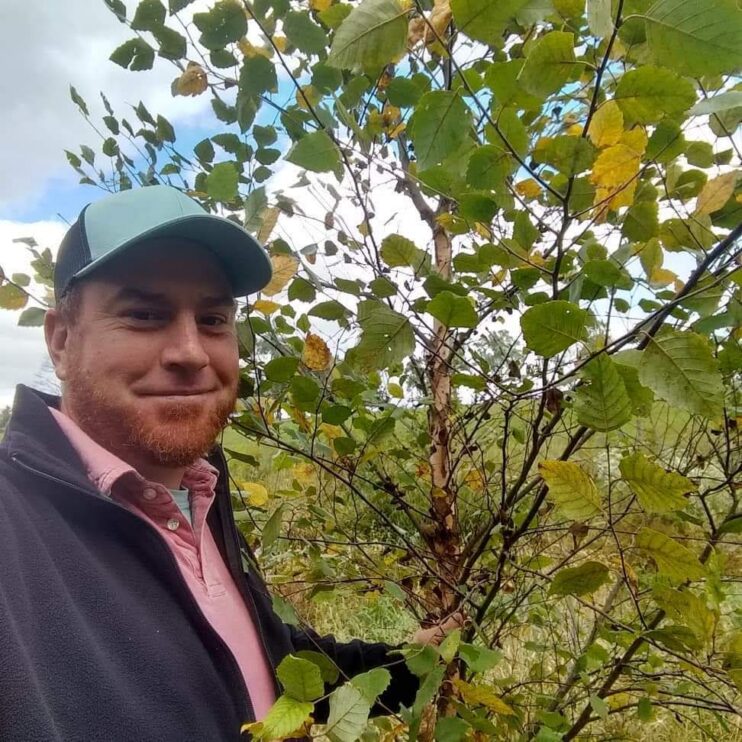
Certified Chesapeake Bay Landscape Professional Justin Ulanoski founded his company Native Creations in 2013 with a focus of bringing his knowledge of native plants into residential and commercial landscapes. (Photo courtesy Justin Ulanoski)
“We hit each other up about projects and management of projects we are working on,” he says. His CBLP and conservation network has also led to new clients and contacts. He notes that his small business is “based out of a little town in Northeastern Pennsylvania that nobody has heard of” but he has done extensive work in Pennsylvania as well as Maryland, Virginia, and even Georgia.
With his CBLP training and 20 years of experience, he became a member of two advisory committees with Pennsylvania’s Department of Conservation and Natural Resources: the Riparian Forest Buffer Committee and Lawn to Habitat Committee.
With more than 1,600 people certified so far, CBLPs are part of a growing network of green infrastructure and conservation landscaping experts. Connections to a community of professionals with the same goals and interests and desires for the Bay.
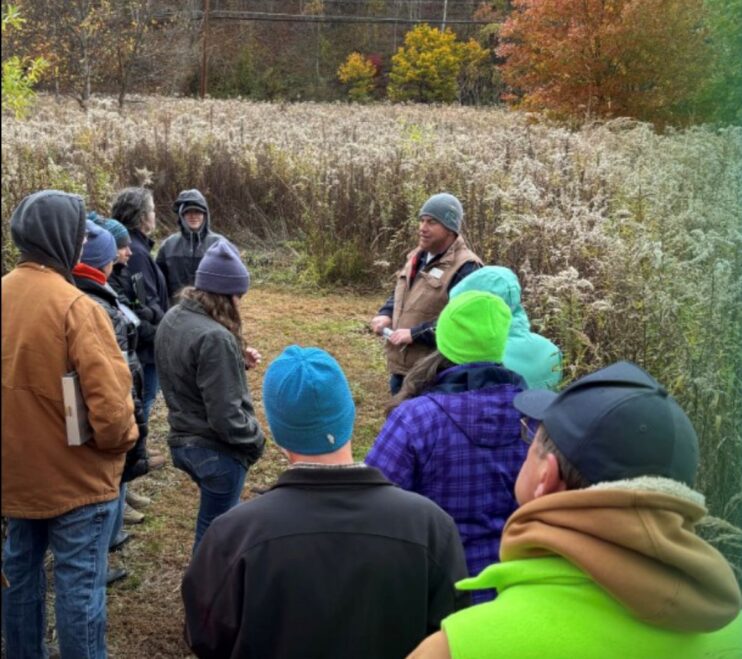
A scene from a CBLP training, where participants take part in field experiences and hands-on learning opportunities. More than 2,000 certified professionals have taken CBLP training. (Photo by CCLC)
Justin had a background in riparian buffers and general landscaping, but when the CBLP training was offered in Pennsylvania he jumped at the chance to learn more about different aspects of conservation landscaping techniques like rain gardens, bioswales, and other types of green infrastructure. After earning his certification, Justin became an CBLP-Buffers instructor and member of the CBLP steering committee that provides strategic direction for the program.
He appreciates that the CBLP certification helps clients know what he can deliver. “Having that behind our names does assure our clientele that we know what we are doing,” he says.
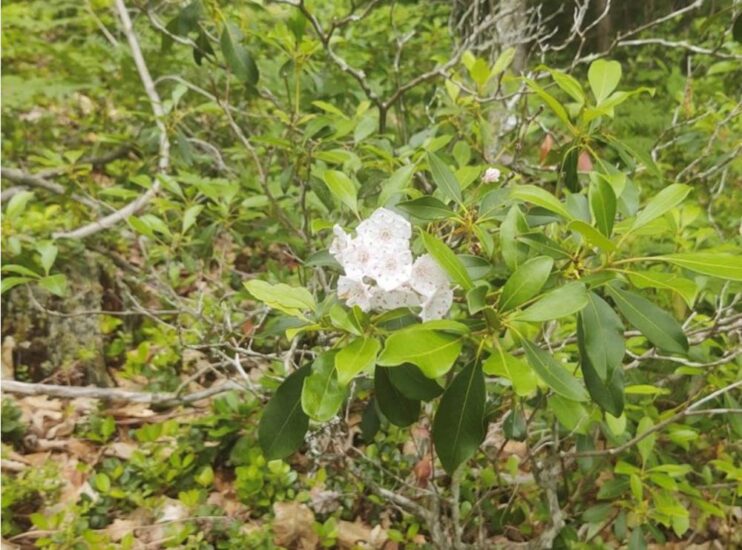
As a CBLP, Justin educates clients about why native plants like this Mountain Laurel are good choices for their properties. They are functional, support the ecosystem, and are beautiful and easier to maintain. (Photo courtesy Justin Ulanoski)
Justin sees education as part of his work with clients. He finds that well-intentioned people will see a plant like Barberry available in a store and want it for their yards, not understanding that the plant may be invasive or detrimental in other ways. “Plant blindness is a curse but also a good thing. Knowing plants, you can’t look at the forest the same way again.”
Working with clients ranging from backyard neighbors to medical centers, universities, and large businesses, he has built a successful portfolio. “There’s not a county in the state I haven’t planted a tree in, not to mention a lot of Appalachian tree work and restoration work.”
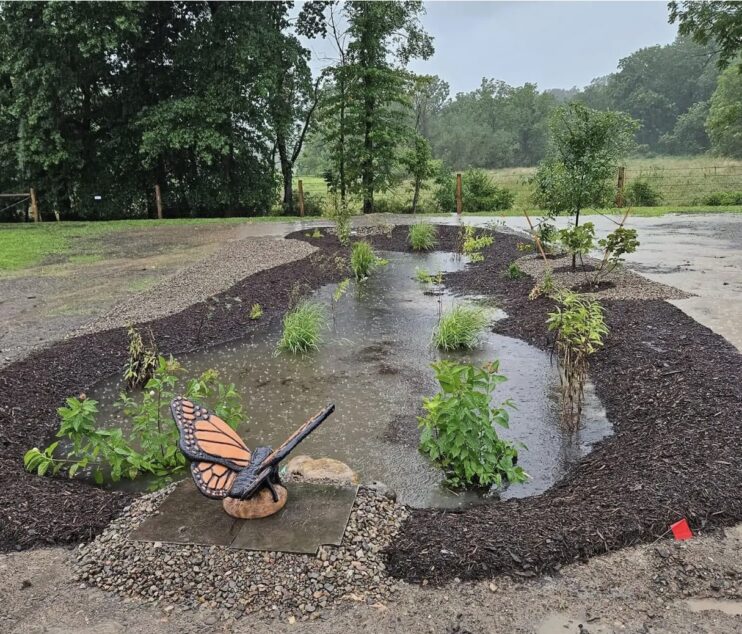
CBLPs like Justin can help clients manage stormwater on their property to prevent pollution and sediment from reaching local waterways. That’s a big benefit for the health and future of the Chesapeake Bay. (Photo courtesy Justin Ulanoski)
CBLPs Can Help You Create Natural Landscapes that Save Money and Effort
When plants grow and thrive, you save time and resources. That was true for Daniel Landesberg, operations leader for the Geisinger healthcare system, who has relied on Justin for several projects.
On the grounds of one major medical center, he asked Justin what could be done with a large grassy field at the end of a parking lot that was largely out of sight for patients, staff and visitors. Justin’s team removed the grass and turned it into a field of native wildflowers. Daniel explained, “It is beautiful! It adds nice color to the landscape and creates a powerful first impression for patients and staff. Additionally, we no longer have to mow or fertilize, which saves cost and avoids runoff.”
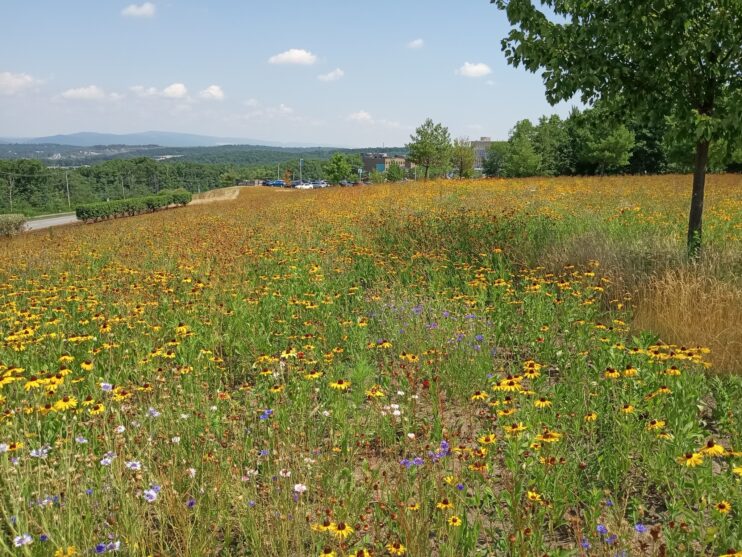
By converting grass into a field of native plants, Justin saved a medical complex from having to mow the area while adding beautiful plantings for patients and staff to enjoy. (Photo courtesy Justin Ulanoski)
The work took place during the pandemic and created a vital place of respite for staff at the biggest and most complex hospital in the region. “There’s always someone out there walking and taking a break and stretching their legs,” he says.
With his training and experience, Justin was able to provide Daniel with talking points about the garden and what was special about the plants. “Wellness and Sustainability are key to Geisinger’s Purpose. Our wildflower field hit on both of these priorities. Furthermore, his advice has been excellent…You can’t ask for a better partner,” Daniel notes.
Geisinger intends to further develop the trail network on property with the wildflower field as a colorful and environmentally beneficial centerpiece!
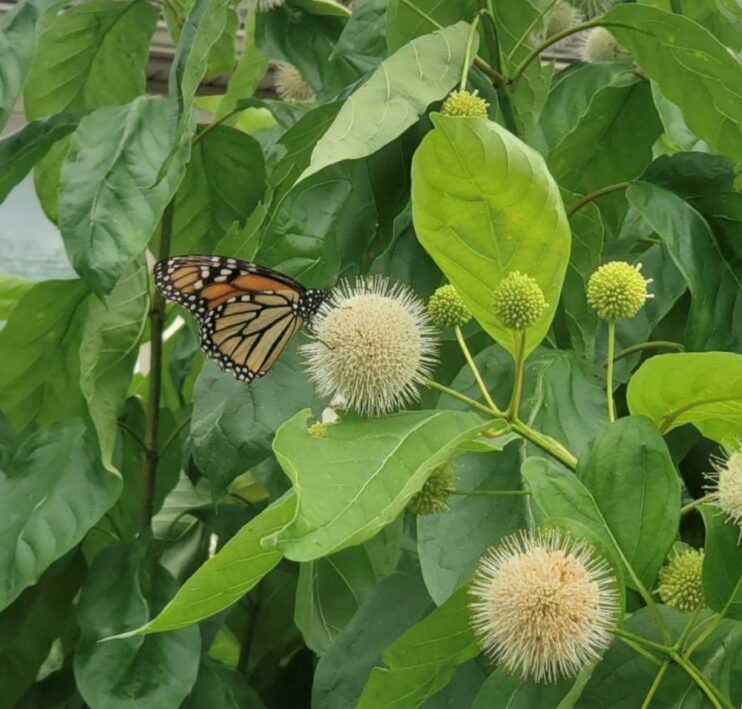
CBLPs like Justin can create native landscapes that support local wildlife and pollinators like this butterfly. (Photo courtesy Justin Ulanoski)
For Clients, CBLP Certification Demonstrates a Professional Wants to Do Things Right
Executive Director of the Northcentral Pennsylvania Conservancy Reneé Carey thinks working with a CBLP can help a client get a better understanding of a landscaping professional. “Initially it gives you some reassurance that the person you are working with has some knowledge and training and is seeking to learn more about what they are doing,” she said.
Her organization first started working with Justin on stream buffer plantings. She was quickly impressed. On one stream buffer project, Justin helped the conservancy have conversations with landowners to find out what they were interested and willing to do, then put together a planting plan, implemented it, and did follow-up maintenance for a number of years. Start to finish, he had the skills to do it all.
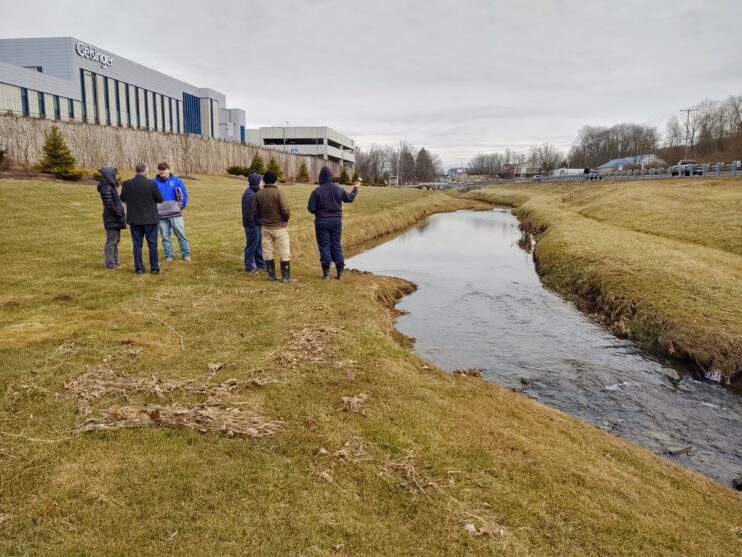
This eroded stream did little to support local wildlife, pollinators, and water quality. Justin worked with the property owner and the Northcentral Pennsylvania Conservancy, Pennsylvania Department of Environmental Protection, Montour County Conservation District, and Pennsylvania Fish and Boat Commission to transform the property. Learn more here and see the team’s completed work below. (Photo courtesy Justin Ulanoski)
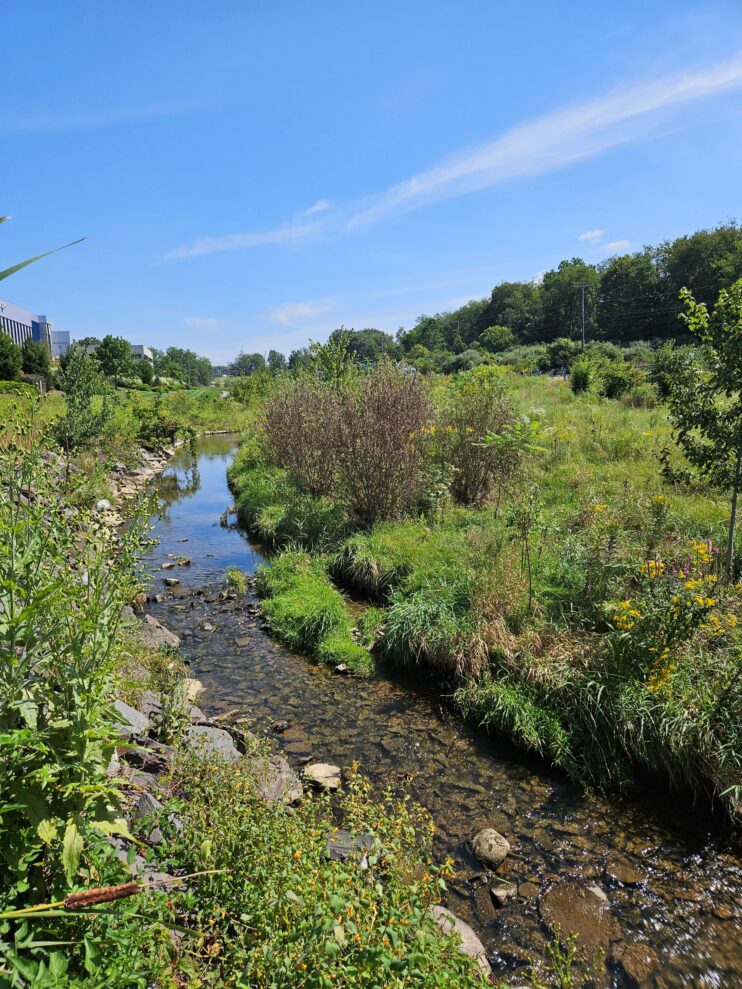
A view of the same stream pictured in the previous picture, after work was completed. Justin’s riparian buffer is made up of plants that reduce erosion and stabilize stream banks, filter out sediments and pollution and benefit pollinators and wildlife. (Photo courtesy Justin Ulanoski)
Reneé appreciates that Justin is always eager to talk about ongoing maintenance and management, “things as simple as tree tubs or shelters or no shelters – things we can do to lessen maintenance for landowners.” She appreciates that CBLPs have an awareness of how working with native plants can help clients build lasting installations. Working with native plants means that in the long run, you are going to have less maintenance and less to plant and replace, she says.
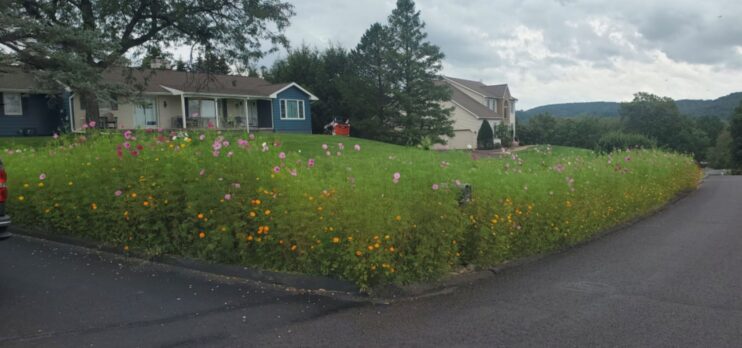
A border of flowers along a yard adds beauty to the property while helping to capture rainwater before it reaches the street. CBLPs like Justin can help property owners develop nature-focused approaches like this on their properties. (Photo courtesy Justin Ulanoski)
With Justin’s CBLP certification, she knows that he is tracking larger trends and the future of conservation landscaping. “This is something he is staying on top of and following developments in and watching funding sources and all those things. He’s paying attention to it all,” she says.
Hire a CBLP: You Can Make a Difference for the Chesapeake Bay
Working with a CBLP can help you turn a corner of your yard into a tiny gem or your entire landscape into a beautiful, nature-friendly panorama that pleases the eye as much as local bugs, birds, and creatures, and supports clean and clear water in your local streams.
With the vast majority of land east of the Mississippi privately owned, property owners have a special responsibility to make decisions about their yards that benefit the environment. When you’re starting a new project, look for the CBLP certification. You’ll be working with a professional who can help you create and maintain a symphony of color, texture, and materials to support the Chesapeake Bay.
Comments? Questions? Learn more about Justin on his Native Creations Landscape Services website.
 Emily Littleton is a freelance writer and advocate for clean water for everyone. After decades as a communications leader at National Public Radio (NPR), she is being certified as a Master Watershed Steward and finding new ways to support the streams and rivers that feed the Chesapeake Bay.