
Look for a Certified Chesapeake Bay Landscape Professional (CBLP) for Your Next Project
This month, we’re sharing the stories of experts who have taken the CCLC’s Chesapeake Bay Landscape Professional training and why seeking out a “certified pro” for your next landscaping job makes sense for you and the environment.
In our first installment, we met David Chewey, a landscape architect based in Virginia Beach who has taken and taught the CBLP courses. He urges homeowners and other professionals to seek out CBLP-trained professionals for their projects. “Every residential site can support water quality and sustainability in some way,” he said.
Today, we get to know Kelley Oklesson.
-Beth Ginter, Executive Director, CCLC
Meet Kelley Oklesson, Landscape Architect & Founder of Groundsmith Collective
CBLP Training: A Rigorous Program Taught by Experts
Landscape architect, Master Gardener, certified arborist, mentor, advocate, and owner of the Groundsmith Collective, Kelley Oklesson was in the first class of CBLP level 1 and 2 classes. She was impressed by the quality of the CBLP training. “The materials that they collected for folks were top notch. The speakers were phenomenal. I learned so much. I still have my notebook on how to do the calculations to properly design a rain garden,” she said.

Chesapeake Bay Landscape Professional Kelley Oklesson “brings a values-driven approach to landscape design rooted in listening, stewardship, and long-term impact.” (Photo by Matt Roth)
The practical focus of the training also helped her communicate better with clients. She’s able to help homeowners understand different terms and break down advanced conservation concepts like green stormwater infrastructure in understandable ways.
Kelley notes that CBLP professionals want to be part of the solution when it comes to taking care of the Chesapeake Bay. “When you work with us you will understand our value quite quickly,” she said.
Discovering the World of Native Plants with a Certified Chesapeake Bay Landscape Professional
The universe of native plants can be difficult to navigate alone. With CBLP training, certified professionals can open your eyes to specific native plants that will thrive on your property. CBLPs have a better understanding than conventional landscapers of how plant communities work together and why companion plantings are important. They also are aware how a project might benefit pollinators and wildlife all year long.
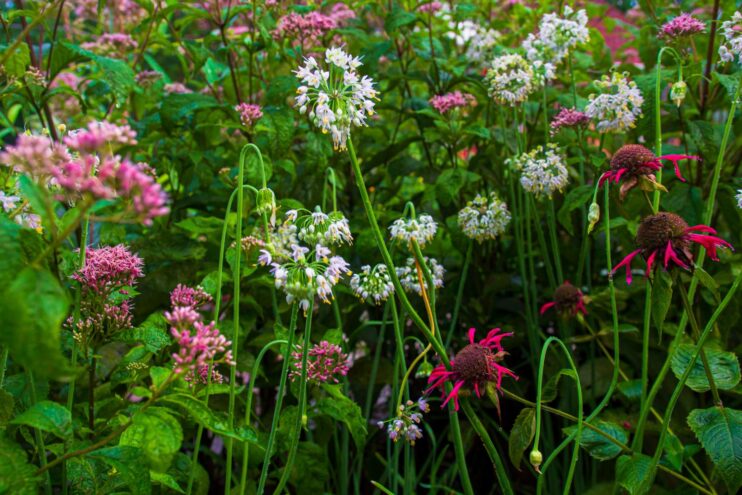
Chesapeake Bay Landscape Professionals like Kelley Oklesson have a deep understanding of native plants and cultivars. In this garden designed by Kelley, bright spots of color are created by Allium cernnum – Nodding Onion, Eupatorium dubium ‘Little Joe’ – Joe Pye Weed, and Monarda didyma – Scarlet Bee Balm. (Photo by Jahnae Neal)
Homeowner Jen turned to Kelley to develop a master plan for her yard in historic Greenbelt, MD. Having an expert’s help was important to her. “In terms of being a gardener, I am not one!” she laughs. She needed help creating a natural landscape with native plants and a redesigned patio space.
Kelley gave her client Jen an appreciation for what is supposed to be growing in her area. “For example, I would never say I am a big fan of hydrangeas but Kelley suggested oakleaf hydrangeas, and I love them. I never noticed them before and now love when I see them around,” she said.
Jen also welcomed Kelley’s expertise not just in what plants to pick, but where to plant them. “Where you put the plants matters. It’s not just the selection of plants but the placement and relationship of plants with each other. Many amateur gardeners don’t have that skill set,” Jen said.
Kelley’s plan is allowing her to tackle the work in small chunks over time. “What we had was just sort of put in. Now it is designed,” she says.
CBLPs Can Steer You Around Landscaping Pitfalls
CBLP pros have seen hundreds of projects over their careers, and they’ve encountered all the pitfalls that can come with outdoor projects. They know how to navigate the challenges that might arise. Maybe your HOA is scared off by plans for “natural” gardens. Maybe your budget is tight and you don’t have much flexibility. Maybe you installed a rain garden but now need to maintain it correctly. CBLPs have the skills to help.
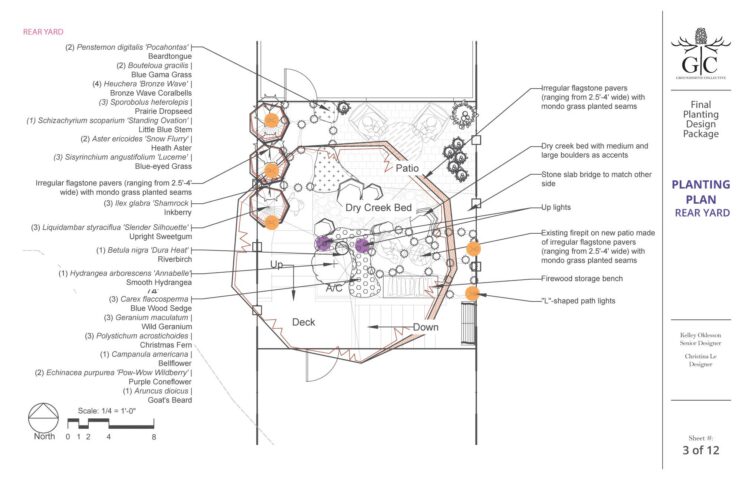
Kelley’s team provides clients with detailed planting plans to show what plants will go where. This is the rear yard plan for Kelley’s client, Clay, whose project is detailed later in this blog post. (Image courtesy Kelley Oklesson)
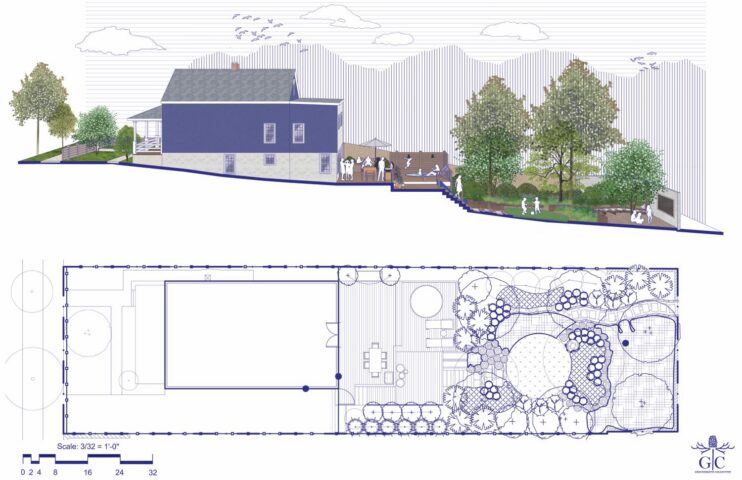
To help clients envision what a completed project will look like, Kelley sometimes uses renderings like this graphic. Here you see a plan view and section elevation of a project in Mount Rainier, Maryland. (Graphic by Caleb Austin)
For Jen, Kelley’s expertise helped develop a plan that works within the rules of her neighborhood housing cooperative. Jen explained that the historic area has firm rules about trees, drainage, wastewater, stormwater management, and keeping things neat and tidy. Kelley’s experience enabled her to develop and refine designs to meet Jen’s needs as well as the needs of her community.
The CBLP Way: Listening and Helping You Achieve YOUR Vision for Your Property
CBLPs like Kelley know that every property and client is different: “You can meet people’s unique needs for their spaces. You can solve for shade. You can do an edible garden. You can even design for play: Boulders in a dry creek bed or bioswale can double as play equipment. You can integrate solutions into a space beautifully, and you won’t even know it’s performing a job. It’s honestly magic.”

CBLPs work with clients to create installations that meet their needs and preferences. For a project at Las Estrellitas Montessori School in Washington, DC, Kelley showed how natural surroundings could be both beautiful and fun. (Rendering by Christina Le)
When Joanne and her wife wanted to turn their front yard in College Park, Maryland, into something special, they turned to Kelley. Joanne was impressed with Kelley from the start. “She had an extensive intake process. She went out of her way to figure out what we wanted. She wanted her design to be geared toward what we wanted and not just her saying ‘this is how it should be.’” Their challenge: a hot, dry, full-sun front yard that was all grass and turned straw brown in the summertime. Kelley helped Joanne realize her goal of a space in between a structured English garden and a mass of wildflowers, with lots of natural colors and stone.
“I have a greater appreciation for working with native plants after working with Kelley. She would talk about the plants she recommends and share photos. I hadn’t seen many native plants and it helped me think about how I wanted it to look. I learned a ton from her,” Joanne says.
Working with Kelley on the yard was “an investment in joy.” She says, “Before when we pulled up, I’d look at the front of the house and it made me sad. Now we both look at our front yard and smile.”

Functional elements like these pavers for a walkway are complemented by
Thymus serpyllum ‘Elfin’ – Creeping Thyme and Asclepias tuberosa – Butterfly Weed in this design by Kelley. (Photo by Peter Hoblitzell)
When You Hire a Certified Chesapeake Bay Landscape Professional, You Build a Relationship
CBLPs earn their certifications to make a lasting difference through their work. They want to see their project in your yard succeed and do what it was designed to do for years to come.
When Clay wanted to make native plants part of his suburban Washington, DC, rowhome’s gardens, he looked at the CCLC’s online directory of Chesapeake Bay Landscape Professionals, did some internet research, and asked for recommendations. When he found Kelley, she was “a perfect match from the beginning. She really understood how to design with existing conditions and for small spaces, and had a commitment to using native species that really matched with my objectives.”
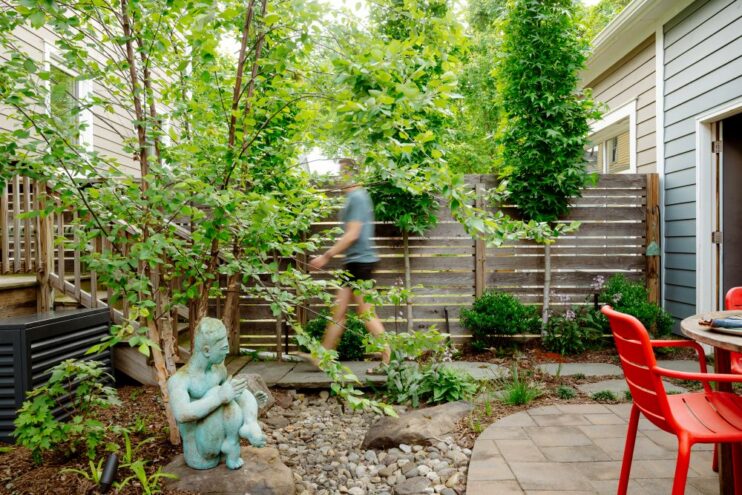
Upright foliage of Liquidambar styraciflua ‘Slender Silhouette’ – Sweetgum creates a green screen while river rock and boulders function as a dry creekbed for Kelley’s client Clay. (Photo by Peter Hoblitzell)
Clay appreciates having an ongoing relationship with Kelley. After work was done he continued to reach out to her with questions. “Kelley is very committed to ensuring that the landscaping that is installed continues to work for clients and that clients continue to understand how to maintain it as it grows in.”
That’s helped him learn about how to care for different species of plants, such as a river birch tree they planted. Clay noticed some yellow crinkly leaves with a black moldy substance on their undersides. Kelley explained that it was nature at work. The birch aphid naturally feeds on the trees and attracts beneficial insects like ladybugs to feed on the aphids, helping expand the ladybug population. With Kelley’s training, what looked like a problem turned into an interesting lesson on the micro-ecosystem happening in his yard.
It’s all in a day’s work for a certified Chesapeake Bay Landscape Professional. Check back next week to meet our next “certified pro.”
Comments? Questions? Kelley can be reached through her Groundsmith Collective website.
 Emily Littleton is a freelance writer and advocate for clean water for everyone. After decades as a communications leader at National Public Radio (NPR), she is being certified as a Master Watershed Steward and finding new ways to support the streams and rivers that feed the Chesapeake Bay.