
Blogger Emily Seamster
October 27, 2026
Whether you have an intermittent ditch, a babbling brook, a raging river, or a lakeside view on your property, the benefits of a riparian buffer are practically the same. Some localities are required to have riparian buffers, which are vegetated areas of a certain width (typically 50-100 ft) adjacent to stream channels with tidal influence or perennial flow, and any connected wetlands. This requirement came to Virginia when the General Assembly passed the Chesapeake Bay Preservation Act in its Tidewater communities in 1988 to help manage and improve Virginia’s non-point source pollution to the Chesapeake Bay. Since the implementation of this legislation, localities across Virginia, and both inside and beyond the Chesapeake Bay watershed have adopted their own riparian buffer requirements to improve water quality. The astoundingly positive results of implementing buffers have been shown to help meet the goals established by the federal Clean Water Act in 1972.
Although many localities in the watershed have requirements to protect existing buffers from new development, there are endless opportunities for voluntary buffer restoration on sites that don’t have a requirement. There are also many buffered sites that have been compromised despite this legislation or were degraded before it was enforced.
If you are considering a buffer on your site, you should also consider the opportunity for buffer optimization based on the unique goals of your property. In this 3-part blog, I will recap the benefits of buffers, offer tips to improve the look and functionality of your riparian forest buffer, maybe even help you make some extra cash from sustainable harvesting of forest products, and help you save on maintenance. I will also tell you about some available funding options. Yes, sometimes you can even get your project fully funded! Stay tuned.
Inherent Benefits of Buffers
Riparian buffers prevent erosion and sedimentation, which also decreases nutrient loading. Many problematic nutrients get into the water from untreated runoff of stormwater that contains suspended sediment. This is especially important near highly agricultural areas that use pesticides and fertilizers, to prevent excess nutrients getting into our waterways from the over-application of those products.
Roots in the soil help to stabilize the stream bank, acting as reinforcements holding the soil in place and preventing erosion. Vegetation on the surface in a buffer zone acts as a natural filter, slowing down the flow of water, and allowing sediment and nutrients to settle out and be absorbed and used as passive fertilizer to plants within the buffer. Slowing down the flow of runoff will also prevent the high volume and speed of water coming down a shoreline slope from degrading the bank and incising the stream. This will extend the life of the stream channel and increase the benefits of established stream morphology to its aquatic inhabitants.
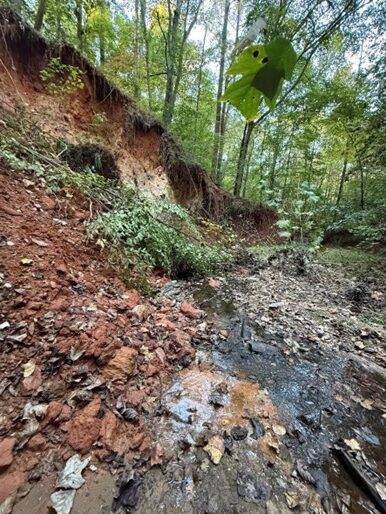
Deeply incised channel downstream of a highly populated area with extensive impervious surface cover, causing high volume and intensity of runoff. Although the stream channel in this photo is buffered, upstream land-use conditions have caused degradation. These conditions would likely be much worse if there were not a well-established buffer on this reach of stream.
The slower movement of stormwater can help to recharge groundwater by allowing it to permeate into deeper layers of the soil. These days, with the concern of drawing down the groundwater table from the water usage demands of local residents, industrial entities and data centers, we need to take every opportunity to balance out these demands.
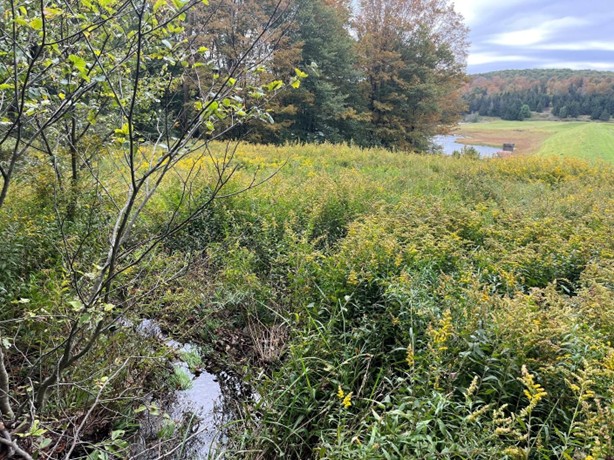
Well-vegetated, primarily herbaceous stream buffer, upstream of a drinking water reservoir in Pennsylvania. This buffer provides natural filtration for runoff entering the reservoir, reduces the overall volume of runoff, and helps to recharge the groundwater.
Another benefit is carbon sequestration. Vegetation, especially woody vegetation like trees and shrubs, captures and stores carbon from the atmosphere as the plants mature. Carbon is a greenhouse gas; therefore, buffers can contribute to combating climate change.
Ahhhhh, Shade
Aquatic species, including everything from small macroinvertebrates and insects to large anadromous fish and amphibians, enjoy the relief of shade in hot weather just as much as you and I do! If your riparian zone is on the bank of a river, you might be thinking “how will my small area make much of a difference”, but just consider how nice it is on a 100 degree sunny day to find that big tree in the middle of the parking lot, or to not have forgotten the umbrella at home for a day at the beach. Your buffer could be the trendiest new fish hang-out spot (and possibly your new favorite fishing hole).
And all the unpleasant algae that keeps coming back every summer; shoreline vegetation and buffers can help with that too! Algae thrive in nutrient rich, warm water. Vegetation absorbs excess nutrients and provides a cooler environment along the edge of the water, preventing those ideal conditions that would allow algae to thrive.
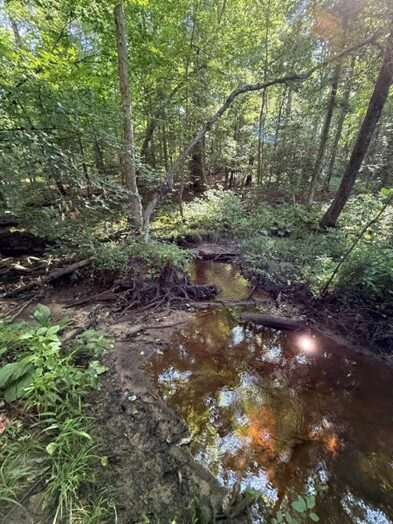
A healthy well-shaded stream channel with tons of happy macroinvertebrates.
Ewwwww, Invasives
Vacant land is a free-for-all for invasive species, in which you can guarantee a perpetual need for maintenance. Would you like to know about a passive way to keep invasives out and have your buffer be self-maintained for years to come?
It takes a little bit of work at first to establish the right community of plants for your project, but it is an investment that will continue to pay off for the remaining future. Native plants have adapted to their ecosystems over several millennia to be able to give and receive in their relationships to the other plants and animals around them. Invasives often attract unwanted pests and diseases and can create a situation that is not aligned with historic local conditions and can make your property more prone to fires, flooding, and poor soil quality. By planting native species to colonize your buffer, you are taking up the space that otherwise might be overtaken by invasives. And instead of having a negative impact, the native plants will enhance the local ecosystem.
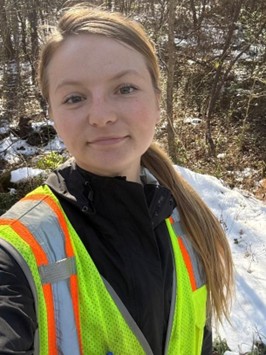 Emily Seamster is a Chesapeake Bay Watershed native, born and raised in Richmond, Virginia. She spent much of her free time as a kid enjoying the outdoors, hanging out on rocks and swimming in the James River. Later, those passions transferred ti her interest in stewardship of the environment as a career path. She earned her bachelor’s degree in environmental science at the University of Virginia. She has worked for a trail crew , improving access to conserved public lands, a wildland firefighting crew where she learned about forest management and fire suppression techniques in the backcountry, and in a summer camp where she led a program educating children on native flora. Emily has nor been with Schnabel Engineering for 3.5 years as an environmental scientist, where she specializes in stormwater management and wetlands. She likes to spend her free time whitewater kayaking and going on adventures with her dog, Charlie. Emily serves on the CCLC Board of directors.