
Emily Littleton
January 12, 2026
Using Algal Turf Scrubbers to Clean the Anacostia River
Larry Davis wants to do more than clean up the Chesapeake Bay watershed. He wants to build stronger communities.
A certified Chesapeake Bay Landscape Professional and past member of the Chesapeake Conservation Landscaping Council’s board, Larry co-founded and leads Green Mechanics Benefit LLC. The ecological engineering firm in Maryland focuses on innovative stormwater management solutions that also provide social, economic, and ecological benefits. That means educational experiences for young people, new jobs, and waterways where people and wildlife can thrive.

Larry Davis of Green Mechanics Benefit LLC is a champion of algal turf scrubbers and other pioneering green efforts.
Photo Credit: Photo Courtesy Green Mechanics Benefit LLC
“Part of our whole paradigm of ecological engineering is really thinking about nature-driven, low cost, locally sourced, high-impact solutions for both the environment and people,” he explained.
Among such projects are algal turf scrubbers, a research-based approach to cleaning up dirty stormwater that he’s installed in Maryland’s Bladensburg Waterfront Park.
Algal turf scrubbers harness the natural abilities of algae to remove nitrogen, phosphorus, and sediment from a water source. The scrubbers consist of an electric or solar pump that pushes water over surfaces (platforms or long flow ways) where existing algae is encouraged to grow. The resulting “algal turf” eats the harmful excess nutrients out of the water as it flows across it. The algae “scrubs” the water clean.
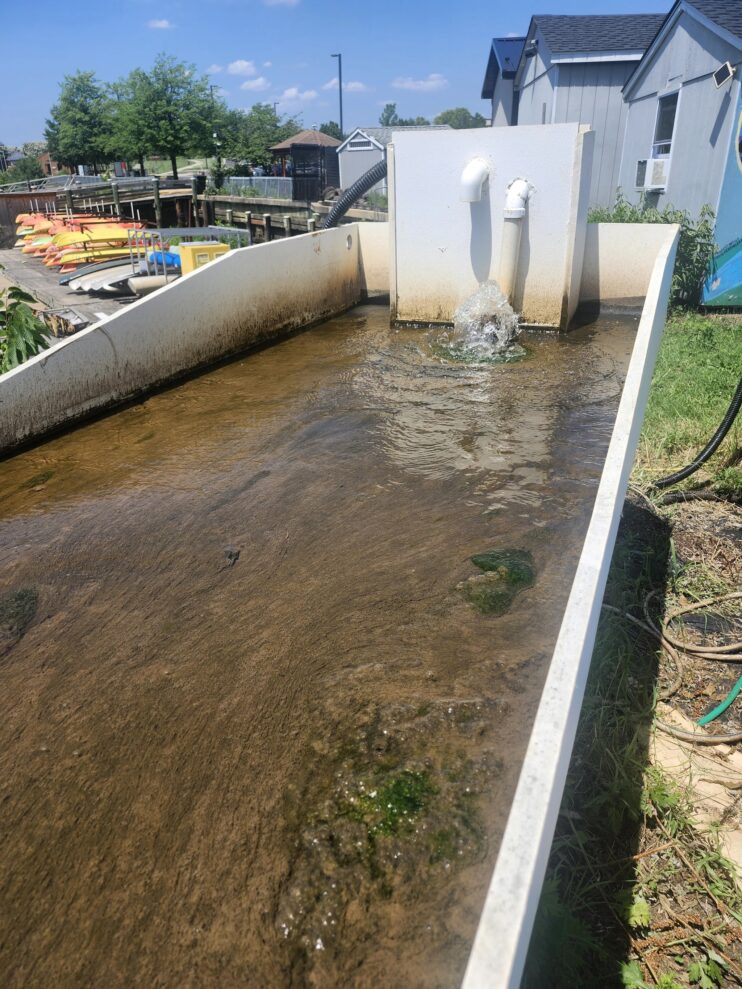
Water is pumped across the algal turf scrubber in Bladensburg Waterfront Park. The algae growing on the system will consume excess nutrients that are pollutants in the water.
Photo Credit: Photo Courtesy Green Mechanics Benefit LLC
Green Stormwater Infrastructure That Pulls Pollution Out of Water
Conservation landscaping tools like bioswale gardens, rain gardens, and native plants catch and filter stormwater and the pollutants it carries – including sediment and fertilizers from lawns or agricultural areas – before it rushes into a stream and makes its way to the Chesapeake Bay. These types of green infrastructure help protect the clean air and water we all depend upon.
But once pollutants like excess nutrients have entered the water, there are not many ways to remove it. That’s where algal turf scrubbers come in.
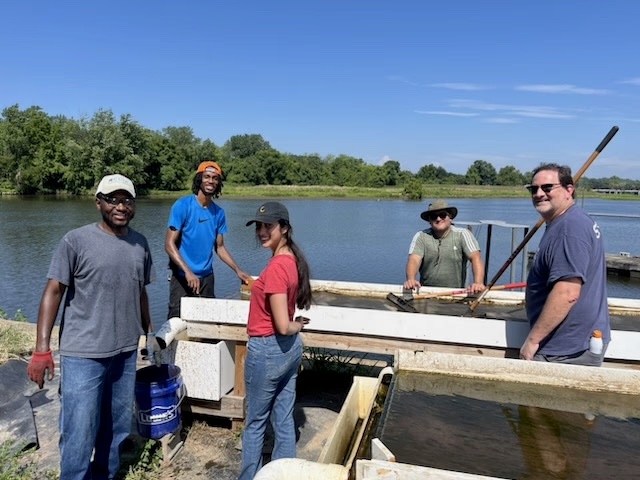
Working on the algal turf scrubber. Larry Davis (left) works alongside Green Mechanics co-founder Justan Randolph, Green Mechanics intern Meena Toolaabee, a volunteer, and Chris Williams, President and CEO of the Anacostia Watershed Society.
Photo Credit: Photo Courtesy Green Mechanics Benefit LLC
Fighting Algae with Algae
Algae feed on nitrogen and phosphorus, taking the pollutants out of the surrounding water. That’s a good thing. But when too much nitrogen and phosphorus wash into a waterway and the weather is hot, bad things happen. Algae reproduce quickly causing “algal blooms” that can block sunlight to underwater plants, suffocate fish and water organisms, release toxins that can be harmful to fish and people, and cause the dreaded dead zones in the Chesapeake Bay.
Larry notes, “Algae does the work of collecting the nutrients when it enters the watershed. But the problem is if algae remains in the water then it is still causing problems.”
Algal turf scrubbers grow algae in a controlled way, so it never reaches harmful levels.
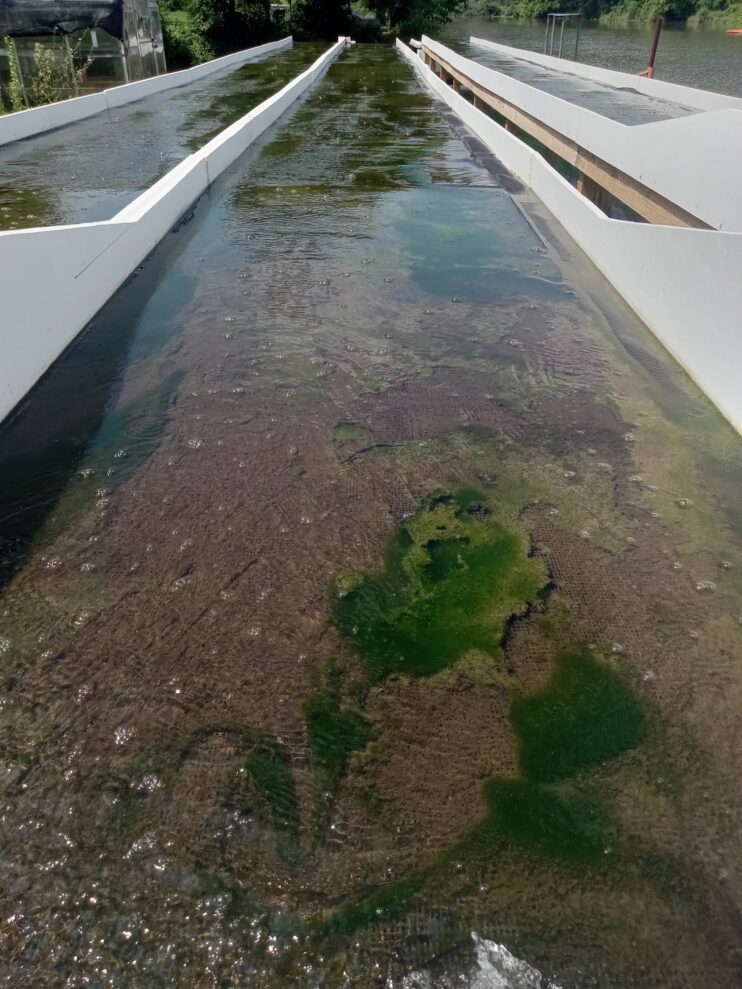
The approximately 50-foot flow ways on the algal turf scrubber in Bladensburg allow a significant amount of algae to grow. An even bigger, one-acre system is in the planning stages to be built with partners.
Photo Credit: Photo Courtesy Green Mechanics Benefit LLC
Once algae is growing in an algal turf scrubber, Larry’s team uses tools similar to car wash squeegees to periodically scrape the algae off the system. That makes room for new nutrient-hungry algae to grow. He explains, “We give the algae a haircut that stimulates the microscopic algae to kick it into high gear to grow at a faster rate. We’re working with nature to accelerate the impact. Every time we give it a haircut it grows more algae more quickly.”
A pipe system then takes the scraped algae to open frames where the sun dries it into a flaky, structured material that can be stored.
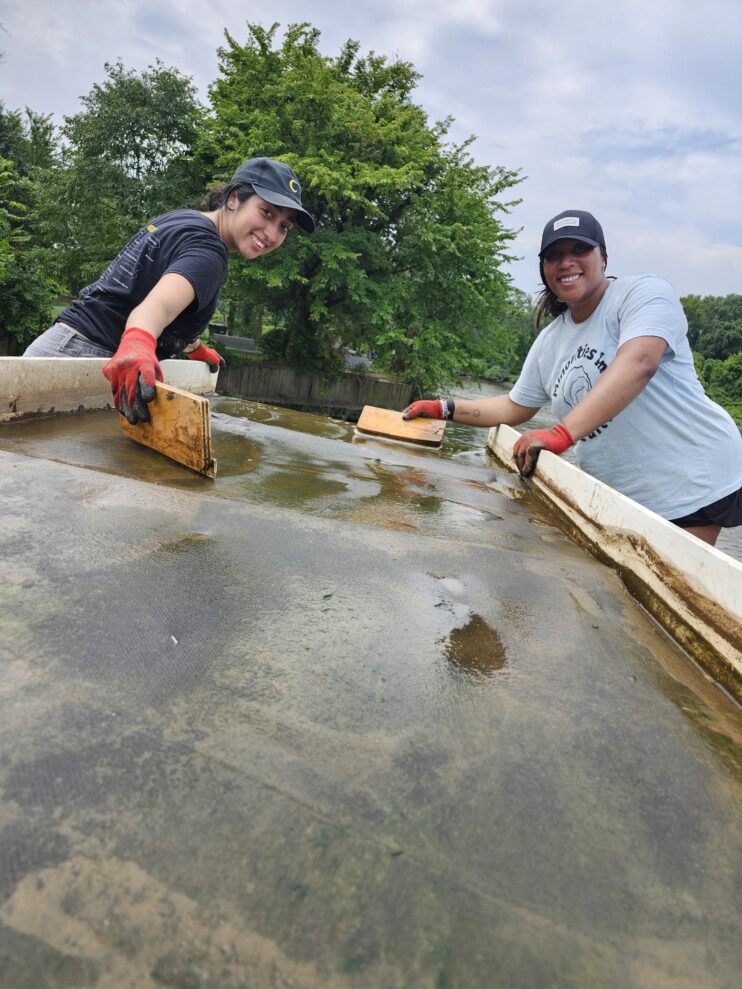
Algal turf scrubbers require periodic maintenance to work efficiently. Green Mechanics intern Meena Toolaabee (left) joins Imani Black (right), Founder and CEO of Minorities in Aquaculture (MIA), to scrape algae from the turf scrubber system in Bladensburg.
Photo Credit: Photo Courtesy Green Mechanics Benefit LLC
Building Blue Green Infrastructure on the Anacostia River
In 2023, Larry’s team installed a pilot algal turf scrubber along the Anacostia river in Bladensburg Waterfront Park in Maryland. “It was to be installed partly as an educational amenity so that folks that travel to it and kids can learn about algae and how harvesting it is a way to clean up the Bay and watershed by removing it in a nature-based approach,” he explained. It was also a way for the park to meet its pollution reduction goals.
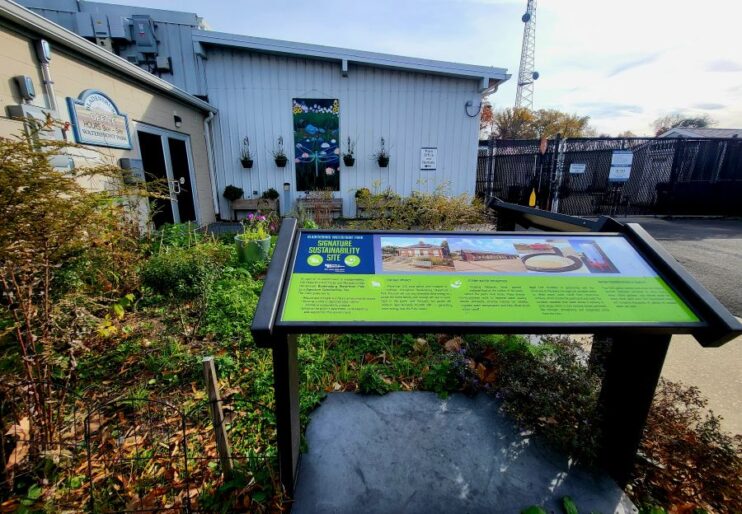
Bladensburg Waterfront Park is designated a Signature Sustainability Site by the Maryland-National Capital Park and Planning Commission. The algal turf scrubber is one way the park is mitigating the effects of pollution and stormwater runoff.
Photo Credit: Alliance for the Chesapeake Bay
Larry explained that algal turf scrubbers are officially registered as one of the technologies property owners can use to minimize pollution as required by law. (The scrubbers are described as “Algal Flow-way Technologies” in the official list.) “We refer to turf scrubbers like kidneys for the Bay or your watershed,” Larry notes.
The system features a flow way about 50 feet long. The site has had notable visitors from ecological supporters including Serena McIlwain, Secretary of the Environment for the Maryland Department of the Environment, as well as Christopher Williams, President and CEO of the Anacostia Watershed Society.
Larry is in the planning stages to install a much larger, acre-sized system in the park in the future. This will be the first of this size in the Midatlantic region. It’s notable to Larry that it’s being built in Prince George’s county. “Innovative technologies like bioretention first took root in Prince George’s county in the 1990s and then spread across the Chesapeake Bay watershed. We want to repeat history with this huge system. It can be another first that leads the way,” he states.
The current algal turf scrubber is located in the back of the park, behind locked gates. To see it, talk to park staff at the front desk. Larry notes that the park offers boat tours of the Anacostia where you can learn about the history of the region. If his team is on site to harvest algae from the scrubbers (usually done on Fridays between March and October), those tour groups sometimes also get a sneak peak at the scrubber and a live demonstration.
An EcoTechnology Based in Research
The algal turf scrubber owes its creation to a Smithsonian research scientist named Dr. Walter Adey, who discovered in the 1970s on a research trip to the Caribbean that pollution levels next to algae on coral was lower than in the surrounding water. He realized the algae were eating excess nutrients, and the water lapping on the corals kept bringing more within the algae’s reach.
Back home in Washington, DC, Dr. Adey replicated the reef and wave action in the basement of the Smithsonian’s National Museum of Natural History and developed the first algal turf scrubber. Dr. Adey explained on the Smithsonian’s Sidedoor podcast in 2017 that he replicated conditions in a wide range of habitats to test the system. “We did a rocky Maine coast for example and then we did a Florida Everglades and a Chesapeake Bay system with its whole range of salinity, from basically coastal water salinity, all the way to fresh water,” he said. He patented the technologies and continued to advocate for scrubbers after his retirement in 2015.
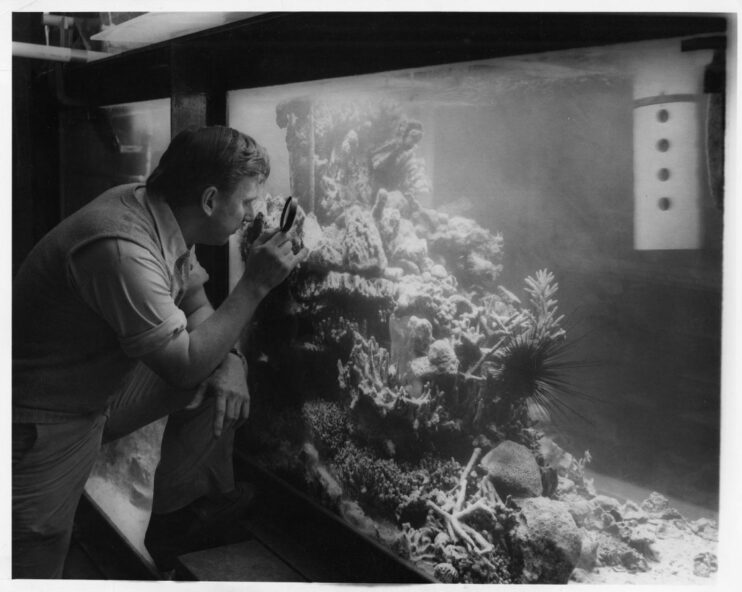
Caption: Researcher Walter H. Adey holds a magnifying glass up to an indoor functioning, growing coral reef he and a team of co-workers developed for the Smithsonian.
Photo Credit: Richard Farrar, Smithsonian Institution, 1979.
The Algal Turf Scrubber Difference
Over time, algal turf scrubbers have been installed in the Chesapeake Bay watershed as part of grant-funded pilots. But Larry believes the Bladensburg structure is one of the few now operating in the Chesapeake Bay watershed. When grants ended, most of the earlier pilot structures were removed. It’s a topic that causes him consternation.
To him, the scrubbers are a low-cost, low-impact way to address water quality that use simple construction materials that can be bought locally and installed with minimal impact to the local environment. Because the algae harvested from the scrubbers can be analyzed, the pollution they remove can be accurately measured. He says from a cost perspective, they are able to deliver a significant water pollution impact per square foot. They can also be strategically deployed at water quality hot spots.
While conservation landscaping practices like bioswales or rain gardens require seasonal maintenance, the scrubbers require weekly support during warm weather months. Larry sees that as a way the scrubbers can provide more educational exposure as well as more ongoing career opportunities in the green industry.
Larry teems with ideas for how algae harvested from scrubbers can be used. “This algae can be used for lots of different things. We’re looking not only at how this system is addressing water pollution in the area but also asking how we can take this dried algae we stored and develop other products and services that can be beneficial,” he states. He described potential uses of algae as sustainable building material or insulation, adding it in marginal percentages to make concrete, or depending on careful consideration of its quality, using it as feed stock or a soil amendment.
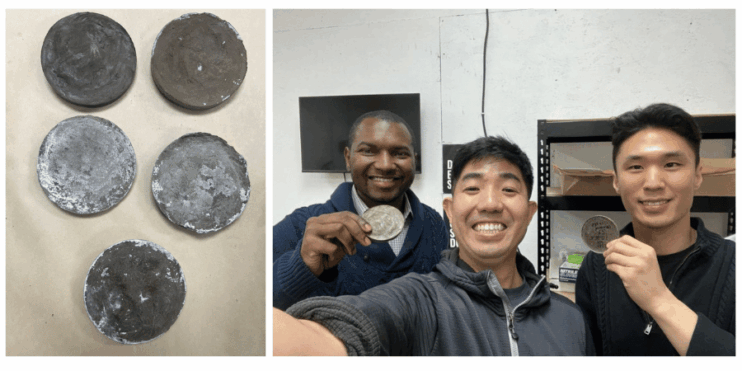
(Left) Prototypes of tiles made from harvested algae intended for use as sustainable materials in construction, sustainable landscaping, or other fields. The tiles were made in partnership with Green Mechanics and JJ Innovative Materials in Baltimore. (Right) Larry Davis displays the prototypes with JJ Innovative Materials COO Mark Wo and CEO Taein Lee.
Photo Credit: Photo Courtesy Green Mechanics Benefit LLC
While used to capture excess nutrients now, Larry sees potential for using the systems in additional ways, potentially even to capture the “forever chemicals” called PFAS. He’s particularly interested in uses near wastewater treatment plants. He notes, “Current solutions for PFAS are costly and expensive. Algal turf scrubbers could be a pathway forward.”
Combining Strategies to Restore the Chesapeake Bay
No one solution will rescue the Bay from the harmful effects of pollution, but a combination of strategies can make a big difference. Conservation landscaping concepts like those described in the CCLC’s Eight Essential Elements of Conservation Landscaping and Chesapeake Bay Landscape Professional training offer a roadmap to a better Bay. Tools like algal turf scrubbers offer potential for cleaner water. Adding them all together, brings us closer to the future we want for the Bay.
CCLC Programs and Engagement Manager Katie Pinkham notes, “Each effort, old or new, combined with the energy of passionate professionals adds to a growing wave of progress. When we combine strategies and work together, we move closer to a cleaner, healthier Bay—and a future full of hope, resilience, and renewal.”
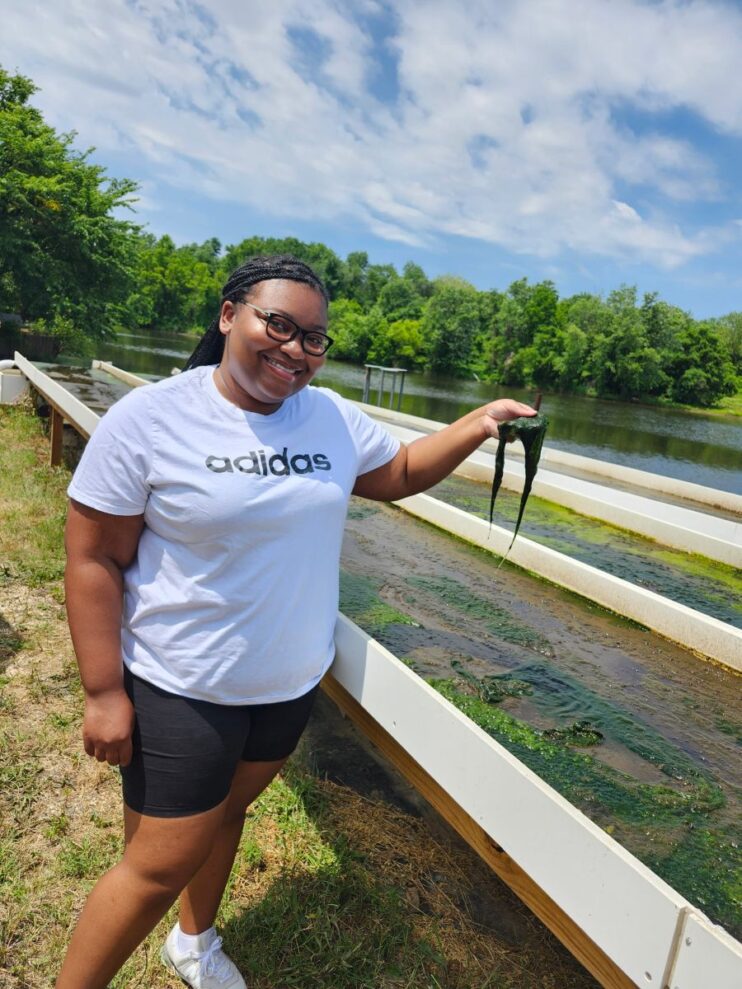
Jamia Staton holds up algae that is working to clean the water at Bladensburg Waterfront Park. Jamia worked with the algal turf scrubber as an intern with Green Mechanics through the Minorities in Aquaculture program.
Photo Credit: Photo Courtesy Green Mechanics Benefit LLC
 Emily Littleton is a freelance writer and advocate for clean water for everyone. After decades as a communications leader at National Public Radio (NPR), she is being certified as a Master Watershed Steward and finding new ways to support the streams and rivers that feed the Chesapeake Bay.