
Emily Littleton
January 27, 2026
Rachael Harrington grew up in nature, splashing through the creeks of Virginia’s Rappahannock River and climbing trees with her sisters in their rural community. She brings her love of the outdoors and exploration to her work as a Chesapeake Conservation and Climate Corps (CCCC) fellow with the Chesapeake Conservation Landscaping Council (CCLC) team and the Alliance for the Chesapeake Bay.
A recent graduate of University of Mary Washington with a degree in environmental science, she sees her fellowship as an opportunity to find her place in the environmental field and see what sticks. “This is a learning year for me,” she shares. “I love putting myself in new situations and seeing where things take me.”
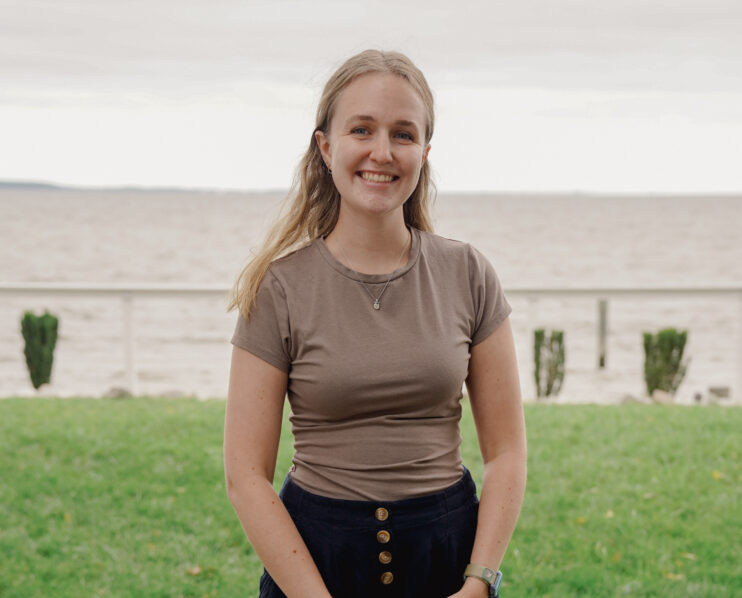
Her fellowship with the Chesapeake Conservation and Climate Corps offers Rachael an opportunity to experience different career options in the green stormwater industry.
Supporting and Learning About CCLC’s Vital Work
Rachael is digging into CCLC’s day to day work, becoming more familiar with green stormwater infrastructure and lending her skills to a wide variety of projects. Among her responsibilities, she’s helping the team create the organization’s first annual report. In the process, she’s learning about CCLC’s many programs and how nonprofits operate.
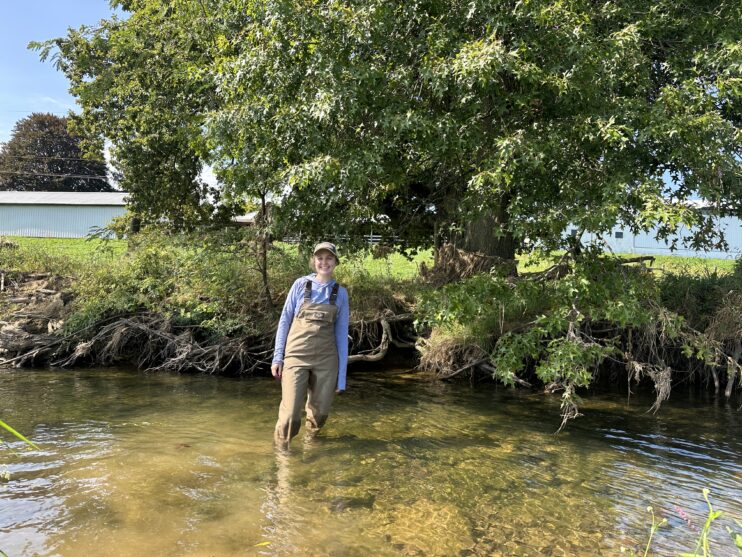
Rachael’s fellowship offers her opportunities to learn more about stormwater management, green infrastructure, and the Chesapeake Bay. Here she takes part in water quality monitoring with the Alliance for the Chesapeake Bay.
She’s already making a difference. Beth Ginter, Executive Director of CCLC, says, “We are so glad to have Rachael with us for her CCCC year, and she has quickly settled in and become a respected member of the CBLP team. Rachael is especially detail-oriented, has a strong sense for anticipating next steps and finding a path forward, and she has a knack for problem solving — all qualities that serve her well in our organization.”
Building the Foundations for a Career in Environmental Sciences
CCLC is connecting her with its growing network of experts in stormwater management and conservation landscaping. She recently helped with CCLC’s biennial Turning a New Leaf Conference and enjoyed meeting other partners and board members. In addition to earning her Chesapeake Bay Landscape Professional (CBLP) Level 1 certification, she completed the Living Shorelines, Riparian Buffer, and Crews trainings. Beth Ginter notes, “We are thrilled to provide her with an opportunity to complete CBLP training and earn credentials while she is also working with us to organize registration, materials, evaluation surveys, and other program logistics.”
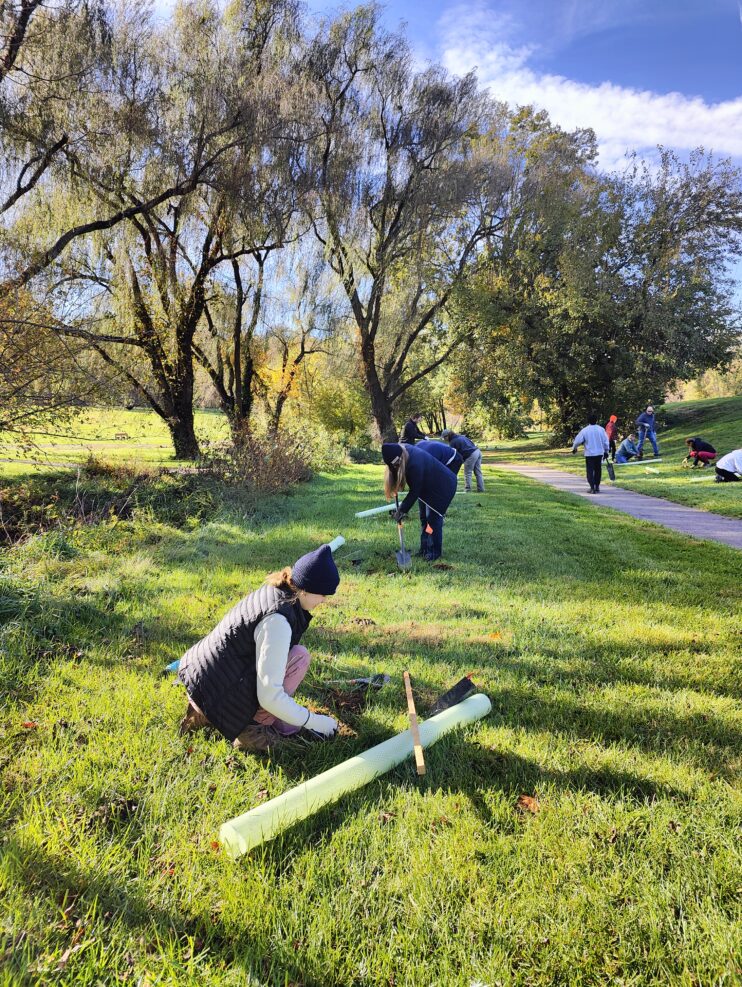
Her fellowship gives her first-hand experience in supporting healthy riparian buffers. Here she plants trees alongside a stream with the Alliance for the Chesapeake Bay.
Her CBLP training is giving her a better understanding of tools like bioswale gardens and how native plants work in bio retention practices and other types of green infrastructure. “I’m starting to identify certain plants on my drive home or pick them out on walks. The flip side is that I’m also identifying different invasives, like phragmites.”
As part of her fellowship, she will complete a capstone project. She plans to organize and lead a volunteer shoreline planting and is already working with some of the CCLC shoreline partners to pick out a site for the work.
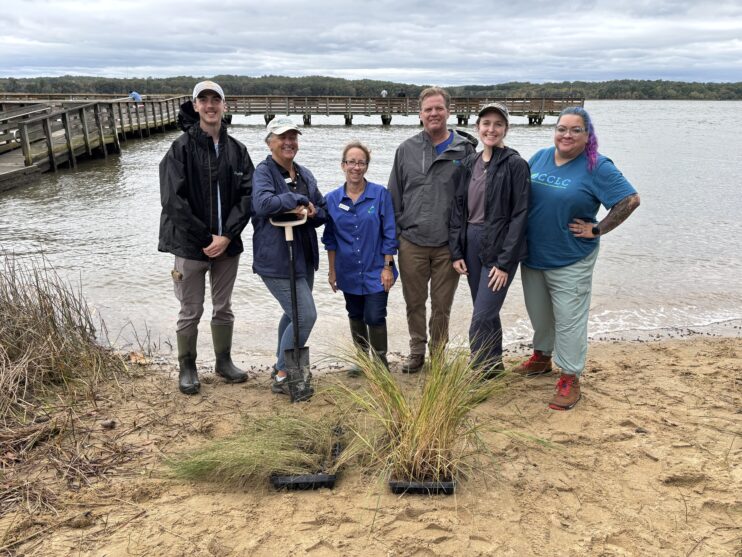
Rachael, second from right, joins members of the CCLC team for the Living Shorelines training that is part of the Chesapeake Bay Landscaping Professional (CBLP) certification program.
A Responsibility to Steward the Land Around Her
Nature has never been far away for Rachael. Her childhood home was surrounded by agriculture and in middle school, she raised pigs as part of 4H’s show and sale program. Her Montessori education taught her to be responsible for the environment around her. To Rachael, that extends to being a careful steward of the land.
In college, she thrived on the interdisciplinary nature of the environmental science program and its opportunities to investigate and study her surroundings. “I enjoy understanding the world around me and am always asking questions about how things work and why they work the way they do.” In her coursework, she examined environmental problems but also delved into their underlying science, such as the chemical reactions when pollutants contact water. She learned about biology, how ecosystems work, and even environmental economics.

In November 2025, Rachael presented her poster at the Alliance for the Chesapeake Bay’s Watershed Forum.
Connecting More Communities with the Environment
“I feel privileged to understand the environment in the ways that I do,” she says. “Not everyone grew up with lots of trees in the back yard and nature they could touch when they want to.” She wants to bridge those gaps between people and connect everyone with nature. Those connections lead to greater awareness and care.
Before joining CCLC, she worked as an environmental educator with Friends of the Rappahannock, introducing young people to the watershed.
Building Green Careers in the Chesapeake Bay Watershed
Rachael is one of about 50 young people in the 2025-2026 Chesapeake Conservation and Climate Corps (CCCC). Funded by the Chesapeake Bay Trust for the State of Maryland, each fellow offers a year of service to nonprofits or governments working in the watershed. Rachael divides her time between the CCLC and the Alliance for the Chesapeake Bay’s green infrastructure team.
Her fellowship is building her personal connections to the Chesapeake Bay. Living near the Bay during her fellowship, she’s eager for the weather to get warmer so she can get out on the water and learn to kayak or paddle board.
“I hope I make a difference. When I complete the capstone and reflect back on my fellowship, I hope I can say I’ve made contributions to both organizations. I’ll be able to see the impact of this year.”
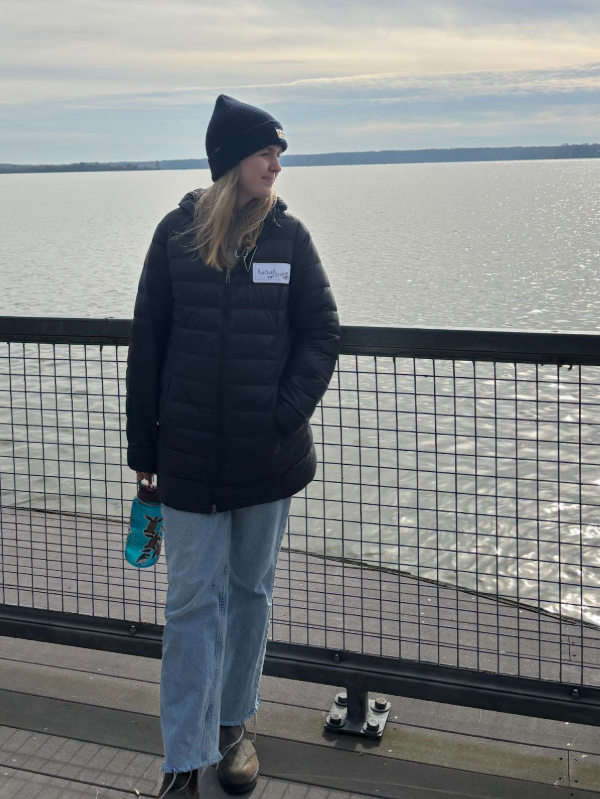
Rachel at CCLC’s Turning a New Leaf field day, visiting VCU’s Rice Rivers Center.
 Emily Littleton is a freelance writer and advocate for clean water for everyone. After decades as a communications leader at National Public Radio (NPR), she is being certified as a Master Watershed Steward and finding new ways to support the streams and rivers that feed the Chesapeake Bay.