
Whether you have a small corner in your yard that you’d like to beautify or manage hundreds of acres at a commercial site, a certified Chesapeake Bay Landscape Professional (CBLP) can help you bring your land to life.
To earn CBLP certification, professionals, including landscape architects, designers, engineers, and maintenance crews attend rigorous classroom training as well as hands-on learning in the field. When you see the certification credential, you know you’re working with a professional who can help your project make a lasting difference in the long term restoration and preservation of the Chesapeake Bay and local waterways.
Over the next few weeks, we’ll be sharing the stories of experts who have taken the training and why seeking out a “certified pro” for your next project makes sense for you and the environment.
-Beth Ginter, Executive Director, CCLC
Meet David Chewey, Virginia Beach Landscape Architect
Landscape architect David Chewey is an award-winning CBLP based in Virginia Beach. He has taken the CBLP levels 1 and 2 courses and serves as an instructor for the program. He urges more homeowners to seek out CBLP-trained professionals for their projects. “Every residential site can support water quality and sustainability in some way,” he said.
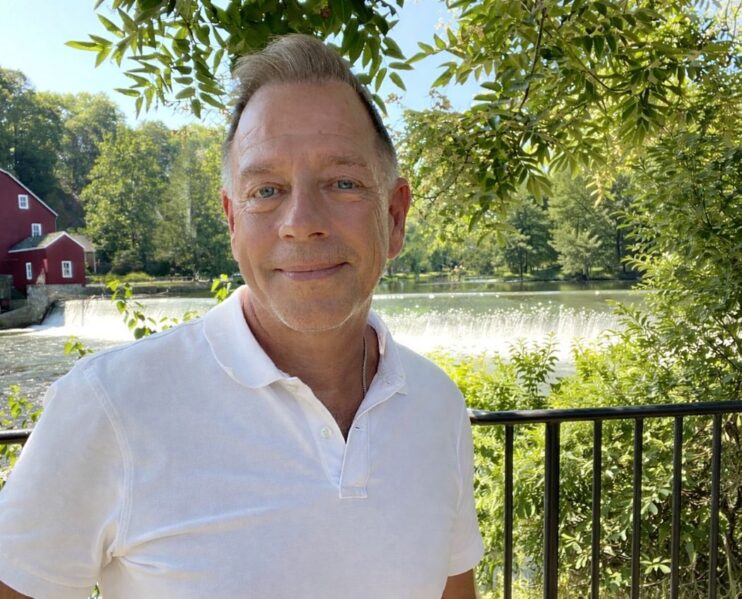
Certified Chesapeake Bay Landscape Professional David Chewey brings 40+ years of experience to his work with property owners. (Photo courtesy David Chewey)
For David, a commitment to nature began at a young age. He launched his first landscape company as a teenager. He graduated from Rutgers University with a degree in Landscape Architecture. Earning his CBLP certification was a natural fit with his interest in building spaces that fit client needs and interests as well as the local ecology. His projects encompass residential garden master designs and planning as well as larger scale gardens for commercial and educational institutions. He is a Licensed Landscape Architect in both Virginia and New Jersey.
David explains that even professionals with advanced degrees benefit from taking the CBLP classes as they fill in important gaps and take deep dives into specific issues relevant to property owners in the Bay region. He has a particular interest in green roofs and sustainable design, which he sees as critical in his local Tidewater region of Virginia.
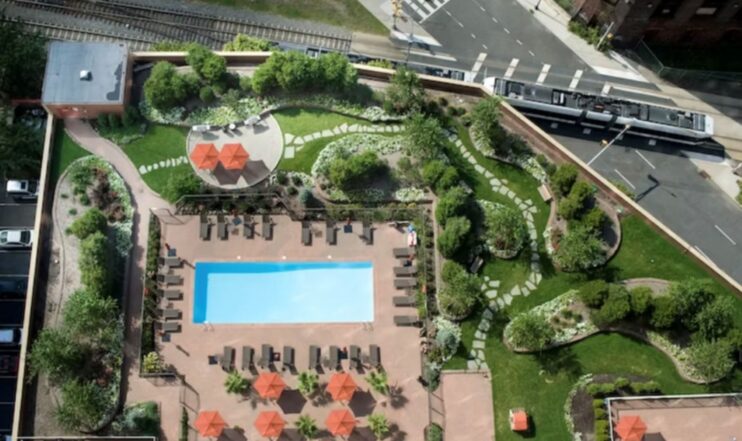
An view of an award-winning, ½ acre intensive green roof project David Chewey designed. (Photo courtesy David Chewey)
Supporting Healthy Shorelines: A Specialized CBLP Certification
David continuously draws upon nuggets of learning from the CBLP courses, which include advanced classes such as CBLP-Shorelines training for professionals working in coastal environments. “I’ve done restorations near water, for example along shorelines, and it’s been good to understand on a more intimate level how those projects can affect the Bay,” he notes.
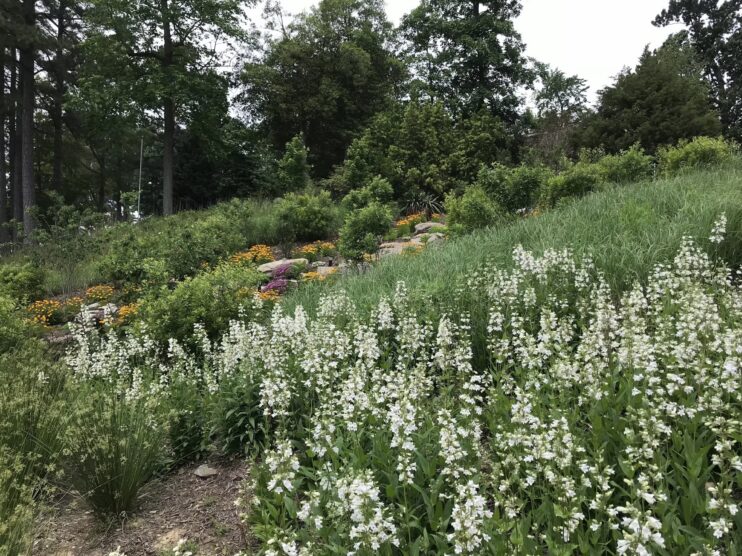
Native plants take the spotlight in David Chewey’s design for a property along the Lynnhaven River in Virginia. (Photo courtesy David Chewey)
David’s client Melody agrees. “We need more people who care about the environment and not just what a landscape looks like,” she says. Melody lives on Virginia’s Lynnhaven River, just around the bend from the Chesapeake Bay. She pays attention to the land and looks for ways to give back. She volunteers to grow oysters off her pier, picks up trash on the waterline, and minimizes use of fertilizers.
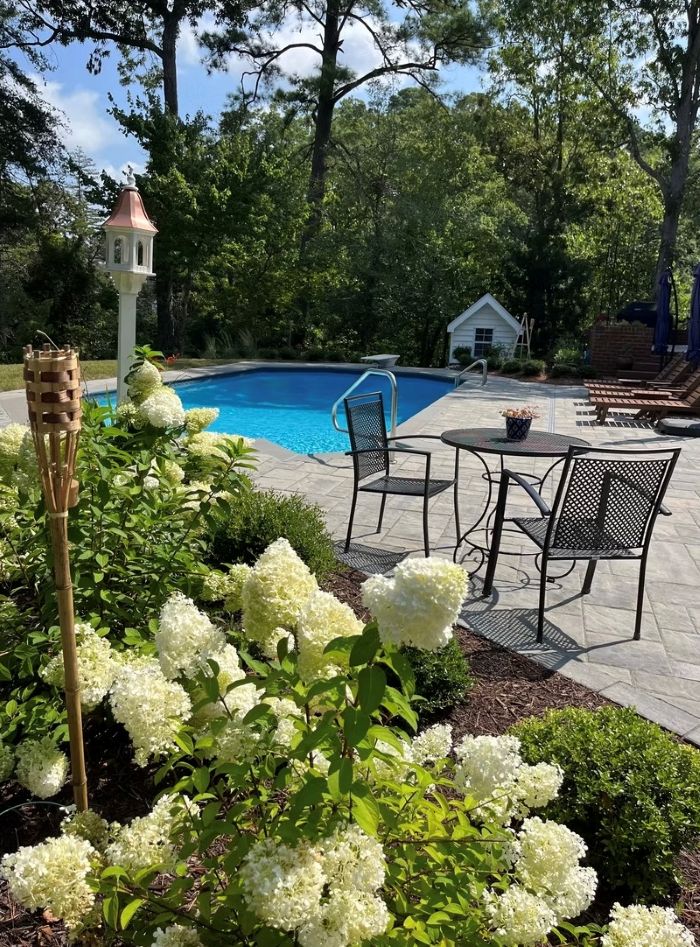
Low-growing plants preserve the property’s water views while helping to slow and retain stormwater. (Photo courtesy David Chewey)
When Melody’s family moved into their home, they encountered a shoreline that had not been maintained by the previous owners. To protect the banks from further erosion and also find ways to rejuvenate the property and its water views, she turned to David.
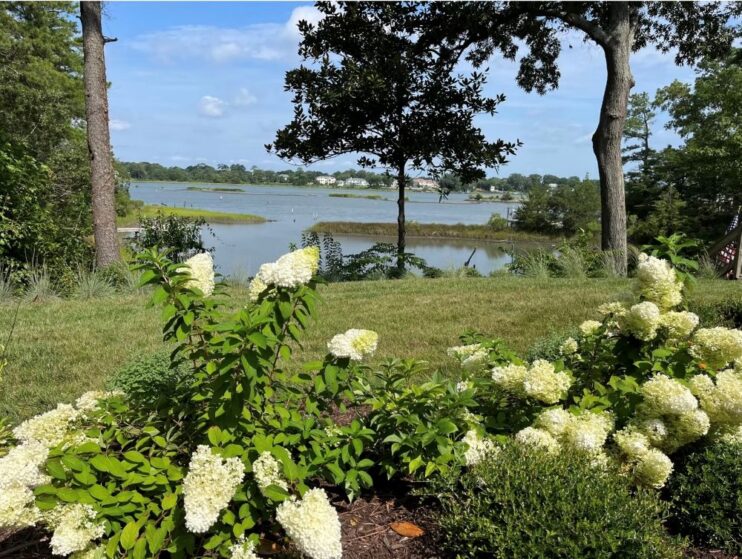
David’s understanding of stormwater management supported his selection of plants to slow and retain stormwater on the property. (Photo courtesy David Chewey)
He delivered a master plan for the property that included permeable paving and several garden beds with native plants like Hydrangea arborescens ‘Annabelle’, Rudbeckia hirta (Black-eyed Susan), Schizachyrium scoparium (Little bluestem grass), Hypericum perforatum (St. Johnswort), Asters, and Polystichum acrostichoides (Christmas ferns) that have offered color and interest year round to Melody’s family and also local wildlife.
The plantings are low enough to preserve a water view but also functional, holding the soil while adding benefits like catching the errant soccer ball before it can escape into the wild area. To extend the walkway around the existing pool in one area, David removed the hardscape and replaced it with pavers and plantings able to absorb and slow the rain.
Hummingbirds now flock to the flowers. Birds, rabbits, voles, and black snakes also make themselves at home. He also removed aggressive vines and moved some existing plants to new locations. He helped Melody secure the permissions and permits needed to work close to the waterline.
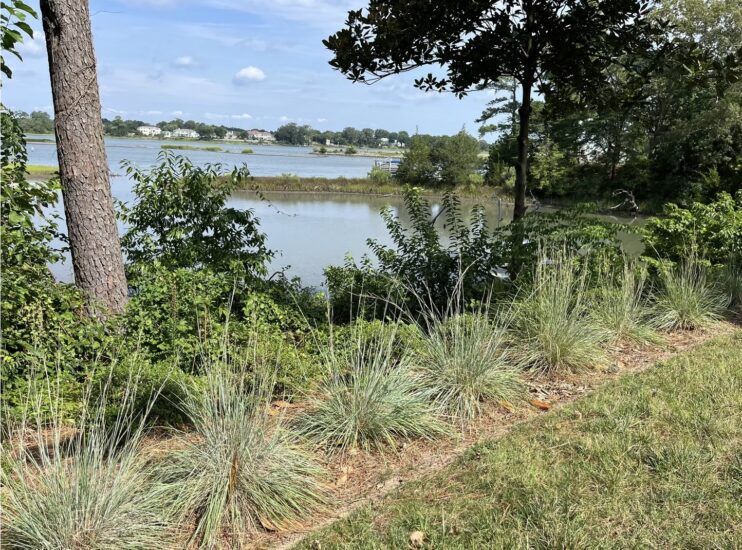
David’s understanding of stormwater management supported his selection of plants to slow and retain stormwater on the property. (Photo courtesy David Chewey)
Melody appreciated that David could offer a holistic plan for her property, in line with her values. “I really appreciate that he saw it as one big picture. It flows together. Since it has been completed we spend as much time outdoors as we can. It has really been very functional for us as well as beautiful.”
CBLPs: Sharing Environmental Learnings with Clients and Building Better Spaces
The CBLP programs along with this 40+ years of experience have given David deep insights into creating sustainable landscapes. He is always eager to share his learnings. “As a professional, it’s fun to expose clients to all the cool things they can do with their properties. It can really surprise them. And these techniques work,” he says.
Learning how to support native plants, soils, and habitat systems is a key part of the CBLP training. David notes on his website, “I have helped re-educate my clients from ‘lawn is good to water’ to ‘meadows or planted buffer areas that are good to the water.’”
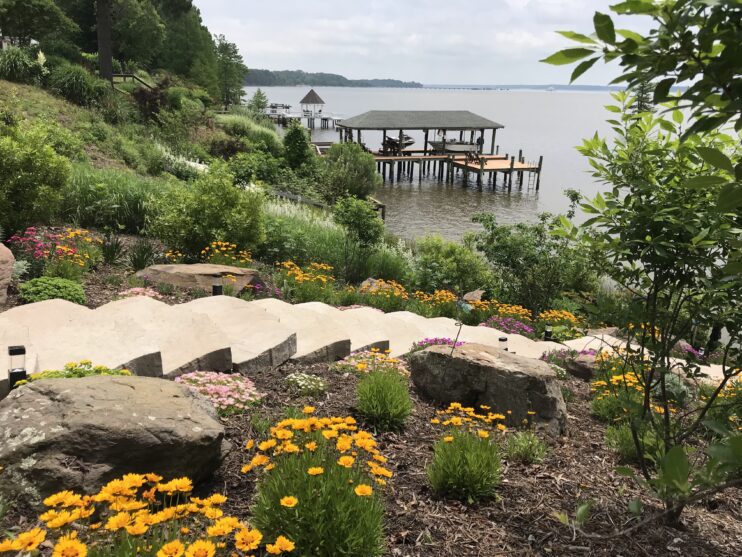
David Chewey designed an upland buffer planting and a shoreline restoration component for a client on the James River. (Photo courtesy David Chewey)
David’s client Jeff lives along the tidal wetlands of the Elizabeth River in Virginia. He came to David for help managing stormwater at his home and to explore how his family might make more use of their backyard. Jeff wanted someone who understood the ecology of the area and had the expertise to know what was possible.
David developed a comprehensive master plan that began with replacing the existing driveway with permeable pavers that would allow the rain to soak in. David then created a new drainage system to carry stormwater runoff from the home’s roof into a rain garden area so it could be more slowly absorbed into the land rather than drain into the river. Jeff was very happy with the work and what it did for the landscape.
David’s master plan included a heavily planted pool area in the back yard to allow the family to make more use of the space. The design included a large, raised rain garden to capture any stormwater runoff from the pool patio before it could enter the nearby river. He explained the garden and underlying drainage system are above the flood level to ensure they functioned properly. These elements were important in David securing the city’s permission to install a project within 100 feet of the shoreline as designated by the Chesapeake Bay Preservation Act. All native plantings were used around the pool to ensure vitality and cohesiveness with the adjacent wetlands.
Jeff appreciated David’s understanding of what the land needed. “He’s the expert,” Jeff notes. “He explained that there were certain kinds of plants we’d want to use because of moisture absorbency – plants that would attract water and suck it up and look pretty too.” He said David had a vision that looked good, solved wetlands issues, and would be approved by the city: “It was a win.”
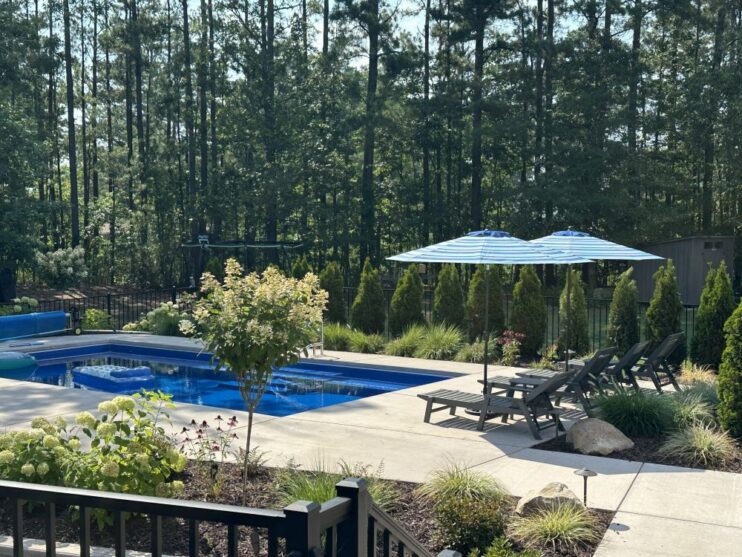
Another view of David’s work for a home near the Elizabeth River. CBLPs like David have the skills and insights to create outdoor spaces that support plant diversity, wildlife, pollinators, and stormwater management while achieving their client’s visions.
Jeff recognized David’s expertise and valued how well he communicated during and after the projects. He is still in touch about how certain plants are doing and what the property needs. When Jeff thought he needed to add more mulch to the beds, he talked to David. “He shared that there was plenty of mulch there and all I needed to do was break it up and fluff it up again,” Jeff said. The learning saved Jeff time and money and allowed existing mulch to continue to break down into the soil.
The family and local wildlife make use of the yard now. While it’s now a space where the family can make memories for a lifetime, Jeff also says “we see birds and deer, rabbits, and fox galore come tromping through.”
It’s all in a day’s work for a CBLP pro like David Chewey, LLA CBLP. David is thankful to the Chesapeake Conservation Landscaping Council (CCLC), which oversees the CBLP certification program and is the leading trainer of conservation landscape professionals in the Chesapeake Bay Watershed. More than 2,000 specialists have taken the training. To find a certified pro in your area, search the CCLC’s online database.
Want to learn more about David? He can be reached via his website.
 Emily Littleton is a freelance writer and advocate for clean water for everyone. After decades as a communications leader at National Public Radio (NPR), she is being certified as a Master Watershed Steward and finding new ways to support the streams and rivers that feed the Chesapeake Bay.