
Blogger Emily Littleton
June 16, 2026
As Virginia’s Elizabeth River ripples by, you may see Perry Verge out for a run or bike ride along its popular banks. Trail time gives Perry an opportunity to appreciate a river that influences the health of the Chesapeake Bay. It’s also space to think about green infrastructure and how people across the region are working together to protect and restore the watershed
Earlier this year, Perry joined us as the Chesapeake Bay Landscape Professional Coordinator for Virginia. Perry supports the CBLP training program, building relationships, encouraging enrollment, and ensuring classes run smoothly. The position is co-funded by CCLC and Virginia’s Wetlands Watch, one of CBLP’s founding consortium partners.
“The role is the perfect combination of my interests. I feel incredibly lucky,” Perry notes.
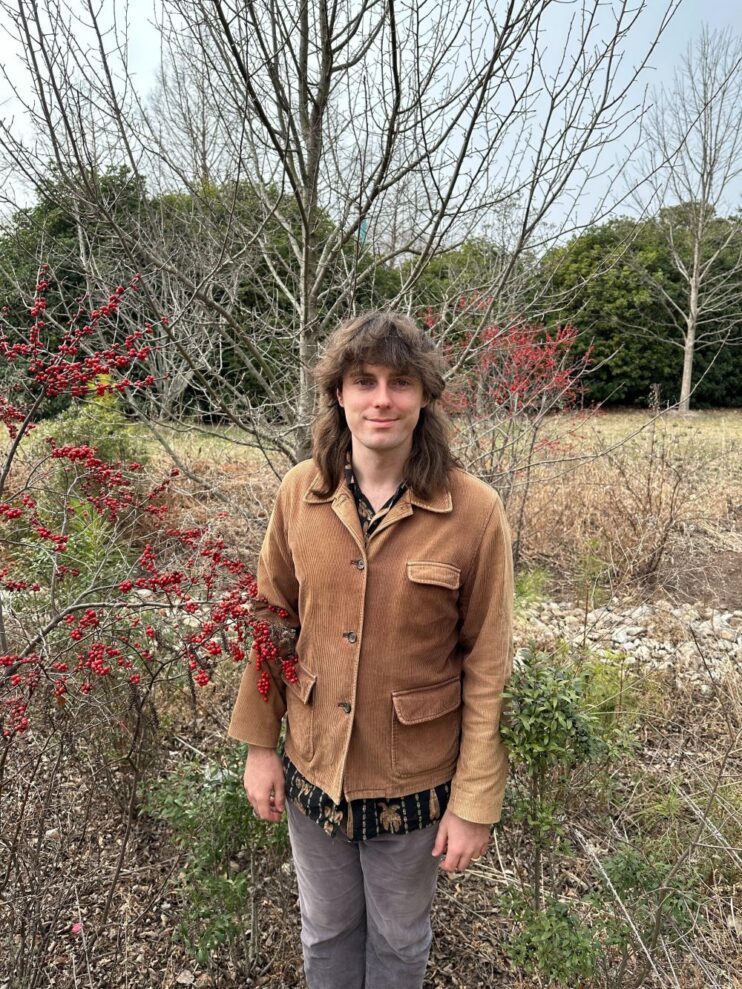
Perry is excited to grown in their role and build relationships in the conservation community
A Background on Chesapeake Rivers and an Early Career in Agriculture
Growing up, Perry spent a lot of time on rivers in the Bay watershed as a member of their high school and college rowing teams. “That helped me love the waterways and see the importance of keeping waterways clean,” Perry said.
After graduating from St. Mary’s College of Maryland with a chemistry major and a minor in environmental studies, Perry headed into the wine industry. Their work took them from California to Oregon and Australia, studying the business from the lab, to vineyards, to tableside service. Their interest in sustainability eventually led them to found their own company to promote wines made from native or hybrid grapes rather than European grapes.
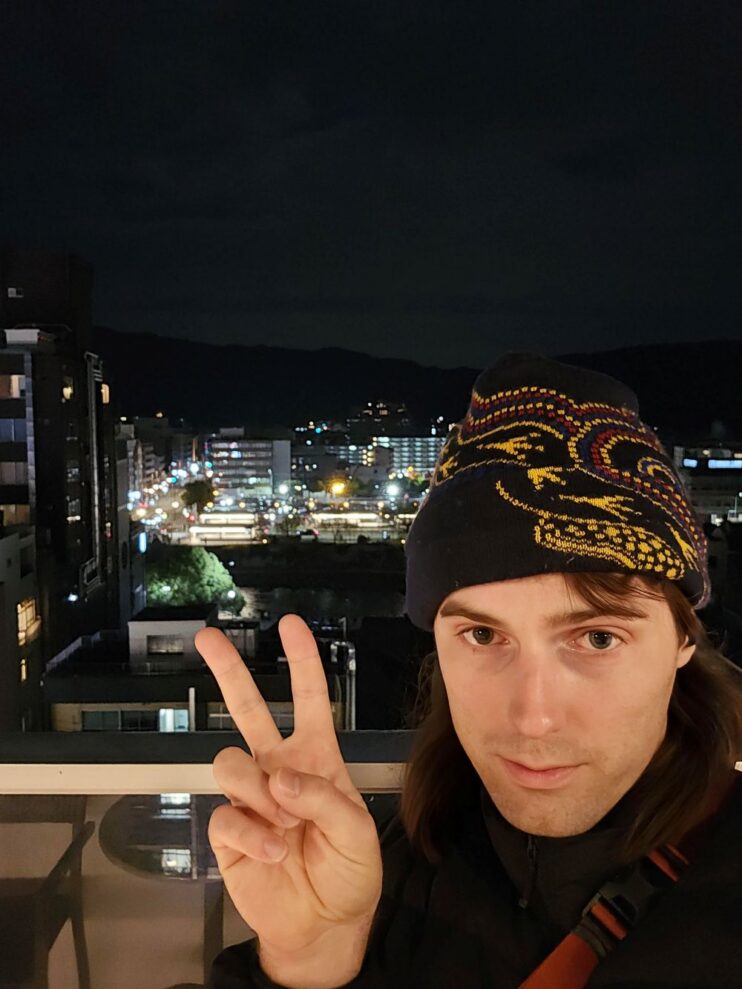
Perry Verge’s lifelong connection to Chesapeake waterways and passion for sustainability shape their work supporting Chesapeake Bay Landscape Professional training across Virginia.
Still feeling like something was missing, they looked for work more broadly focused on sustainability and earned a GIS (Geographic Information System) mapping certification in the process. GIS is an important tool in studying and restoring watersheds. Soon after, they applied for a role with CCLC.
Building Partnerships to Fuel Stormwater Solutions
Perry sees stormwater management as an integrated process, with city planners, community members, and landscape professionals coming together to make good things happen. “It’s really inspiring to see the intentionality behind the collaborations that happen around green infrastructure. There’s room for many partners. It’s great for everyone to specialize in their own thing and then come together to talk about the best way to work together.”
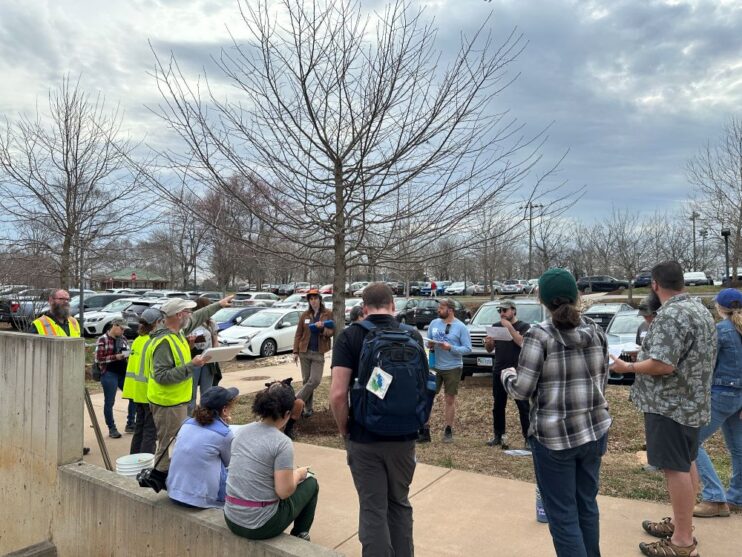
Perry- center, by the tree, joins the CBLP team in a Level 1 Class in Richmond, VA
In their work, “I learn more about the importance of collaboration each day. The environmental problems we are facing are so large and complex that it doesn’t make sense for each of us to solve them on our own. Everywhere you go, people face different challenges and have different resources,” Perry notes. They appreciate that CBLP training respects those differences. Participants learn skills and understanding that can be applied to any project.
Meeting others during classes and becoming part of their networks is equally valuable. For example, during the CBLP Crews training, which is focused on the hands-on maintenance of green infrastructure like rain gardens, participants freely shared information about how they had solved different problems. Those connections can also support solving future challenges.
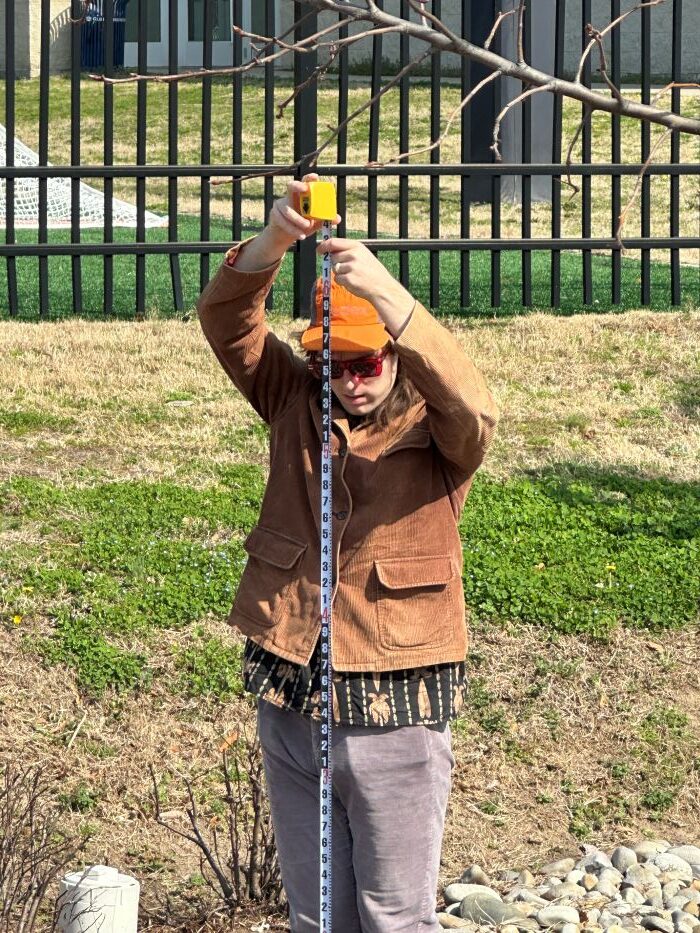
Here Perry is demonstrating how to use tools to measure a stormwater practice
Looking ahead, Perry will be getting more deeply involved in CBLP-Buffers, the’s certificate course in implementing and maintaining riparian buffers. Riparian buffers along waterways capture sediment and nutrients before they flow into rivers or streams, create habitat for plants and wildlife, and reduce water temperature, erosion, and flooding risk. The focus will take Perry to CBLP training across Virginia to the far reaches of the Chesapeake Bay watershed in Allegheny County.
Looking for Green Infrastructure Wherever They Go
When they first joined the team, colleague Stacie McGraw told Perry about an inevitability: There will come a time when you take a trip with your partner and you will have to go to a BMP just to look at it. Perry laughed at hearing it. That had already happened. On their recent honeymoon to Japan, Perry said, “I dragged my wife to see an interesting interactive stormwater BMP and almost dragged her to see a mega flood project north of Tokyo before we realized it would have been too much of a logistical hurdle. But I hope to see it, if we ever go back.”
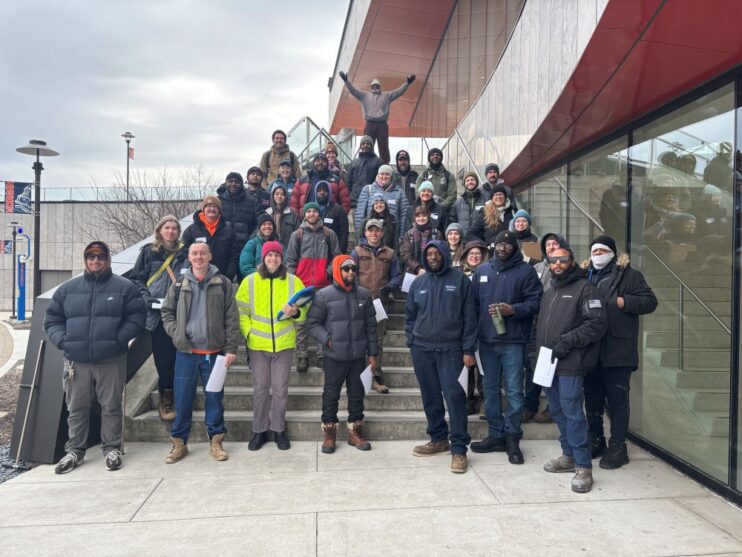
In the first month in their new position Perry joined CBLP classes in Virginia and Maryland- this is from the Baltimore class.
Seeing how cities have addressed transportation and economic needs, stormwater management, and habitat restoration is part of Perry’s lifelong learning process: “I hope we can see even more collaboration between how communities solve their transportation and stormwater management needs. Trails are great showrooms for green infrastructure.”
Seeing a Golden Age of Collaboration in Solving Stormwater Challenges
While they love to travel, Perry stresses you don’t have to leave your hometown to learn more and make a difference. Talking to neighbors and community members about green infrastructure in your area can give you new insights for ways to help. Online networks and connections also offer new perspectives. “I think getting a wide variety of solutions from a lot of different voices is a good way to solve challenges. This can be the golden age of collaboration. If you have good intentions, it’s easier than ever to learn things in new places and in your own places as well.”
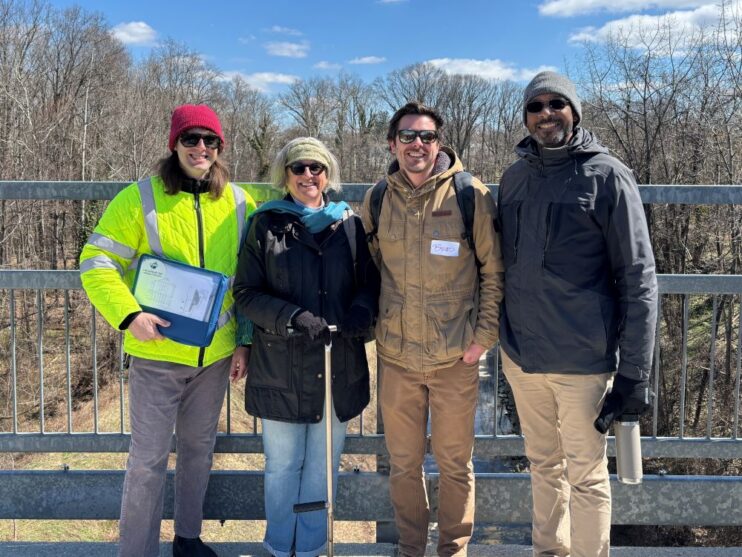
Perry (left) with the rest of the team in Baltimore
Being successful in making change all comes back to appreciating and enjoying the water and the wildlife and people who depend upon it. “If you say conservation landscaping and stormwater management, people’s eyes might glaze over because those are very big municipal words that sound like they belong in a city council meeting. But those words are really about things that people love. Memories of jumping into a lake or going to a beach or seeing a river. Thinking about how nice it would be to be able to swim in a local waterway where you live. Those are fun and human connections to water and why it should be protected.”

Emily Littleton is a certified Master Watershed Steward, freelance writer, and advocate for clean water for everyone. After decades as a communications leader at National Public Radio (NPR), she is finding new ways to support the streams and rivers that feed the Chesapeake Bay.