
Blogger Andrew Conboy
September 8, 2026
Tree planting is a more involved and thoughtful process than most may think! To ensure that the trees we are installing throughout our region reach their full potential, we must pay attention to numerous small details that are often overlooked. Below, I list five common mistakes that are made when selecting, planting, and maintaining trees.
Choosing a Species: Usually, the first step of the process is choosing which species you want to plant and where you want to plant it. Though it seems easy enough, this step is often where some of the first mistakes are made. We tend to choose a tree based solely on its aesthetic value and how pleasing it is to our eyes – traits like flower color, bloom time, foliage appearance, and fall color. And while we certainly must consider those traits, we must first evaluate the site conditions of the planting area.
If your desired tree species does not naturally grow in settings similar to your planting site, it will likely not thrive here. If you plant a water-loving American sycamore in a dry upland site or an acid-loving scarlet oak in alkaline soils, you will probably be fighting an uphill battle to keep that tree alive and growing. To get a better idea of appropriate species for your site, you can observe which trees and plants are already growing or thriving near the planting site, conduct soil tests to determine pH, or read about your area’s underlying geology.
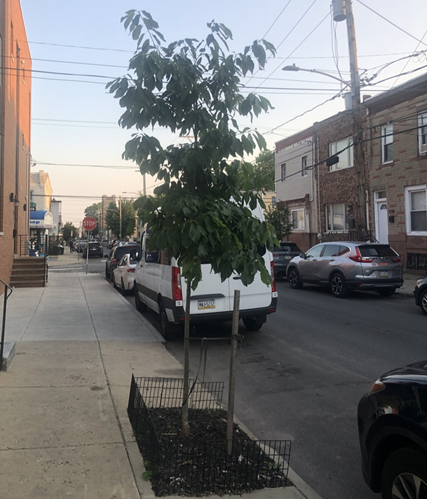
The species selection process begins with assessing site conditions – particularly the soil pH, moisture levels, and sun exposure. The Chinkapin oak (Quercus muehlenbergii) is one of the only native oaks that thrives in alkaline soils, making it ideal for limestone-derived soils and urban areas.
Planting too Deep: If you look at mature trees in a forest, you’ll notice that they flare outwards at the base of their trunk where they meet the ground. This is caused by the large structural roots growing out from the tree’s base. It’s a critical area for the tree – it supports the cumulative weight of the tree and all the forces that act on it. However, when you take a look at trees that were planted in the landscape, you may notice that many of them are missing that “root flare” – that’s usually because they were planted too deep, and the root flare is buried.
It’s even common at nurseries to find buried root flares on trees grown in containers and balled-and-burlap. When we plant these in our landscapes, we must be sure to excavate excess soil and roots around the tree’s root flare, and to plant the tree so that the root flare remains above ground. If buried too deep, the base of the trunk can rot, which makes it more susceptible to disease and reduces overall vigor.
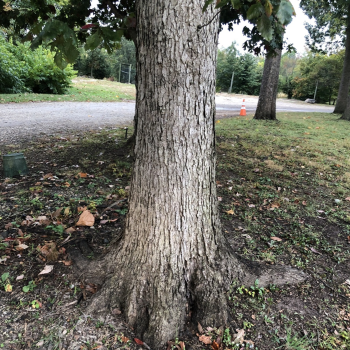
The tree’s root flare, or the point at which the structural roots begin to flare out from the trunk, should be slightly above ground as seen above. When planting, we must be sure to find the root flare and plant it at that appropriate depth.
Mulching Improperly: The “mulch volcano” is an all too common feature of corporate campuses, HOAs, and commercial strips. Many landscapers are taught to pile up mulch high against the tree’s trunk in a mound or volcano shape. A tree’s trunk usually wants to remain dry and exposed to the air, but as mulch piles up year after year, it holds moisture against the trunk and invites potential fungal pathogens.
When applied properly, mulch is extremely beneficial to young and mature trees. It holds moisture in the root zone, encourages soil microbial life, buffers the soil temperature, supplies nutrients as it breaks down, and reduces competition with weeds. Apply 3” of undyed wood chip mulch in a donut shape around the tree. Ideally, the donut would extend to the tree’s dripline, but even a 3 foot radius makes a great difference! Looking for a guide on proper mulch use? Look at this resource from the University of Maryland Extension program.
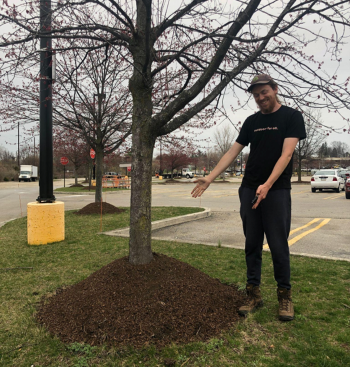
This tree’s mulch volcano is covering its root flare, which holds moisture against its trunk and encourages girdling roots. Mulch should be applied in a donut shape around the tree and not up against its trunk or root flare. This was one of the most noteworthy volcanoes I’d ever seen.
Insufficient Water and Maintenance: Planting a tree is arguably the easiest part; the real work comes in watering, establishing, and maintaining it! These things will require many visits over a long period of time, depending on the size of the plant. A general rule of thumb is that you will have to water the tree regularly for a number of years equal to the trunk’s diameter in inches. For example, if you plant a 2” diameter tree, you’ll have to water it regularly during the growing season for at least two years, and ideally more. This will ensure that you are giving the tree enough time to rebuild its roots after being cut at the nursery.
While they may not provide as much instant gratification, planting smaller trees is a great idea because they require significantly less time and maintenance to get established. They’ll take a few years to reach the size of a balled-and-burlapped tree, but they’ll generally be much healthier and more vigorous. Maintaining a good mulch donut, ensuring deer protection fencing remains intact, and inspecting for diseases are other important maintenance items to do throughout the year.
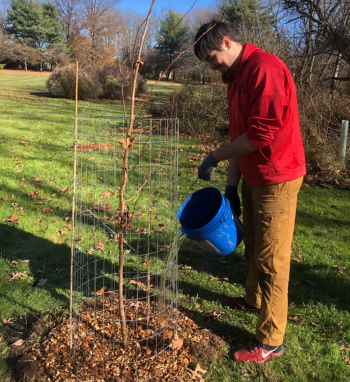
After planting, watering your young tree is the most important maintenance item. New trees should get five gallons of water poured on their root systems at least twice per week during the growing season, and ideally more for larger balled-and-burlapped trees.
Training a Good Form: So you’ve planted the tree, watered it until it was established, protected it from deer until it grew tall enough, and maintained a nice mulch donut around the base. One of the final mistakes we make with young trees in our landscape is becoming adverse to pruning. Young trees, especially those that are growing in full sun with no competition for light, usually require a bit of guidance to help them grow into a strong form.
Generally, trees are much more structurally sound when they grow into a single, strong central trunk with smaller branches growing outwards. This is especially true for large-maturing species like most Oaks (Quercus), Elms (Ulmus), Maples (Acer), and Hickories (Carya). If your newly established tree has two different leaders that are competing for dominance, it is a great idea to prune off or reduce one of those so as to select the leader that will grow into the central trunk. Branches that form an angle that is too tight against the trunk or parent limb may require pruning as well.
Overall, improving structure when a tree is young, healthy, and vigorous can significantly reduce the risk of structural failure (splitting, limb dropping, etc.) in the future. The pruning wounds are also much smaller and easier for the plant to deal with. Ideally, structural pruning will commence a year or two after tree establishment, and continue on a yearly basis until a strong structure is formed. This step may require a knowledgeable arborist, but it is certainly worth investing in!
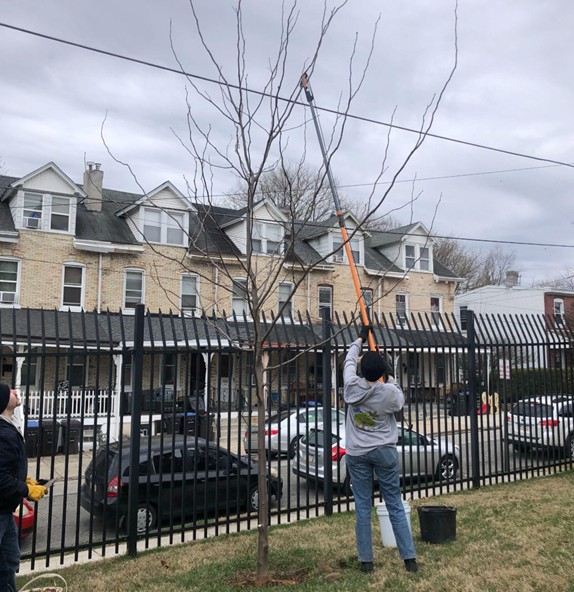
Doing structural pruning on your newly established trees can help improve their form and reduce the risk of limb failures as the tree matures. Pruning is ideally done in winter when the tree is dormant and its structure is easier to see.
 Andrew Conboy is an urban forester and ISA-certified arborist. Through his work at Morris Arboretum & Gardens, on social media platforms, and through his ecological restoration nonprofit Community Canopy Project, he hopes to inspire a wider integration of native trees, plants, and greenery into the spaces where we live, work, and relax. His user-friendly content on social media platforms (@Andrew_The_Arborist) aims to educate and encourage people to connect with the natural world around them.
Give him a Follow on YouTube | Instagram | TikTok | LinkedIn | and at the Community Canopy Project