

Blogger Beth Ginter
September 23, 2026
I’ve been thinking a lot about green infrastructure maintenance, for several reasons.
In May, we taught a private CBLP-Crews class for a school district that had some of the worst-looking stormwater best management practices (BMPs) I’ve seen. Keep in mind that I’ve seen hundreds (perhaps thousands?) of BMPs over the last 10 years. These were extraordinarily bad. It serves no one to point fingers at the school or the management crews- we know the struggles they face. We must accept that the current approach to BMP maintenance is flawed. I firmly believe that we all need to talk more about this, support those who are working the right the wrongs, and encourage our funders to support maintenance.
Secondly, we published a white paper on green stormwater infrastructure (GSI) maintenance this summer. This project allowed us to dive deeply on this subject, gathering input from different types of stakeholders doing this work and managing BMPs across the region, which precipitated deep thinking on this subject.
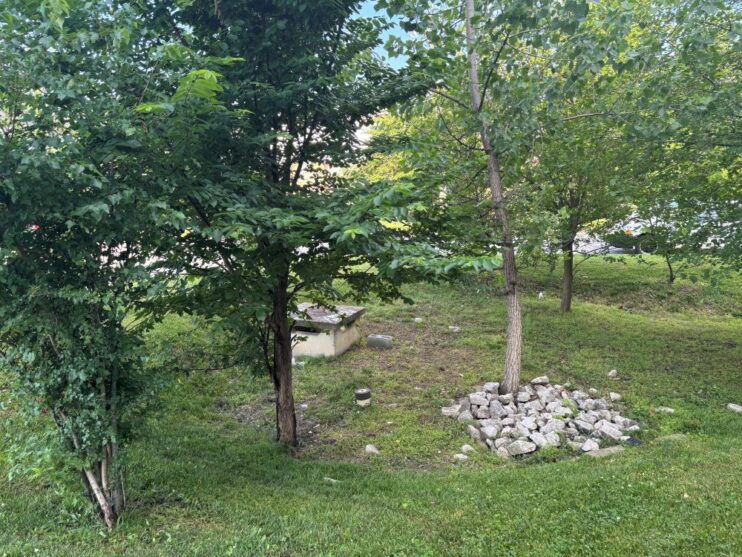
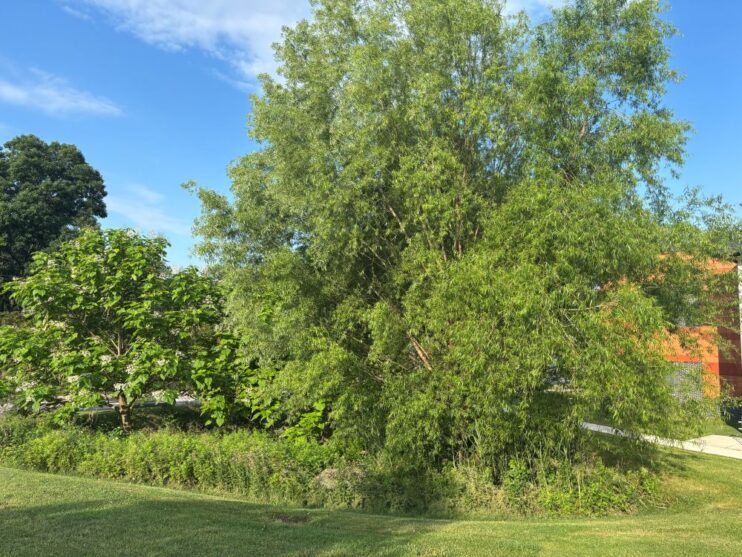
These bioretentions exemplify two extremes of what we affectionately call “baldy,” scalped clear of any vegetation except for trees, and “shaggy” in which no vegetation management is happening. These, of course, are common maintenance pitfalls.
The maintenance crews we trained at the school were eager to learn and understand. They recognized and readily acknowledged they lacked the skills and knowledge needed to do a good job of caring for these BMPs.
These school BMPs had been in the ground for several years, and the crews had zero training before we arrived. This is not an issue with the crews. It illustrates a wider systematic failure, as evidenced by:
-
- Multiple BMPs were installed but no maintenance plans had been shared with the crews.
-
- There is no specific budget allocation for GSI maintenance, nor understanding of what is needed, or how long it will take.
-
- BMPs are managed as part of the regular “mow and blow” maintenance budget.
-
- Crews received no training on native plants, invasive plants, how to distinguish one from the other, or how to effectively manage invasives.
-
- Crew supervisors, likewise, are not trained on GSI and do not understand routine/nonroutine management tasks.
Facing so many hurdles, how could these crews possibly successfully manage BMPs to ensure they are aesthetically pleasing as well as functioning as designed to reduce the negative impacts of stormwater?
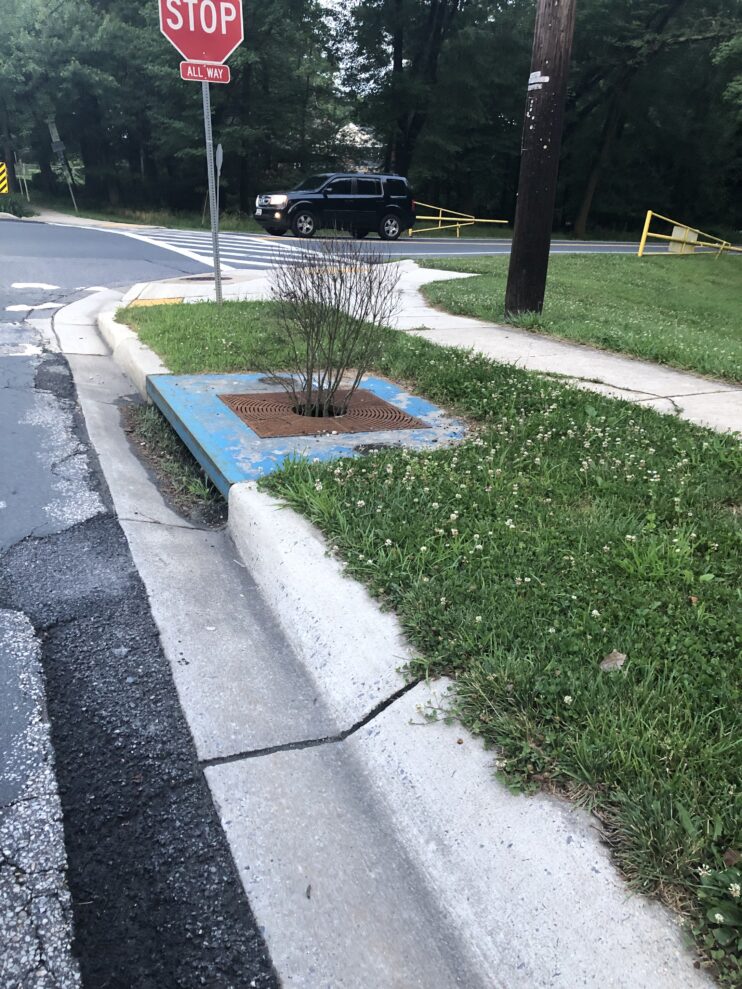
Beth noticed this Filterra on her drive that could use maintenance
At the risk of beating a dead horse, again, I say: As a region that invests heavily in green infrastructure, we must all insist that maintenance become a priority rather than an afterthought, and work to correct these shortcomings. It’s critical to protecting our investments. This is a bit overly simplified, but here’s the Rx, as outlined in the recent white paper:
-
- Include maintenance teams in the design process from Day 1 of all new GSI projects.
-
- For agencies and others who manage large GSI inventories, consider applying a “Level of Service” model, common in other municipal sectors, to prioritize maintenance.
-
- Properly train crews, as well as managers and key decision makers who manage budgets and direct operations.
-
- Consider nontraditional stewardship models, including working with highly-trained volunteers or workforce development programs.
 Beth Ginter, MPSLD, CBLP
Executive Director, Chesapeake Conservation Landscaping Council (CCLC)
Beth became CCLC’s first executive director in January 2020. Based in Silver Spring, Maryland, and working across the mid-Atlantic region, CCLC educates and supports professionals to implement sustainable landscapes and green infrastructure practices for a healthy and resilient Chesapeake Bay watershed. She helped develop and also direct CCLC’s Chesapeake Bay Landscape Professional (CBLP) certification initiative. Previously, Beth was the founding principal of a landscape consulting & design firm, and she directed scientific communications programs in the corporate sector. She earned a Masters in Sustainable Landscape Design at The George Washington University and a B.A. from Virginia Commonwealth University.